

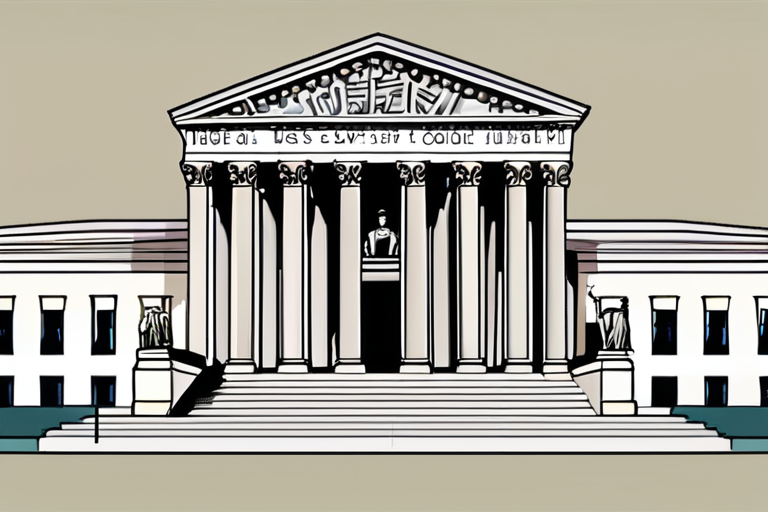
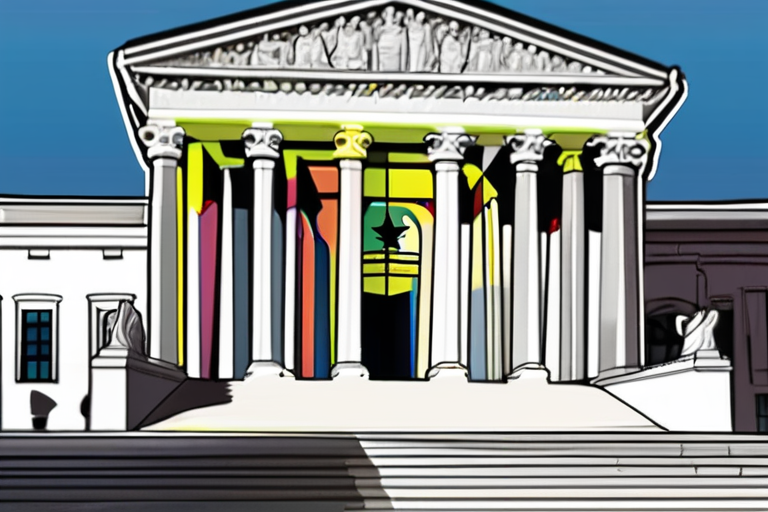
As the Supreme Court prepares to hear arguments in Hamm v. Smith, a case that could redefine the boundaries of "cruel and unusual" punishment, the nation is holding its breath. The fate of individuals with intellectual disabilities hangs in the balance, and the implications for the death penalty are far-reaching. But what exactly is at stake, and how did we get here?
The story begins nearly a quarter century ago, when the Supreme Court ruled in Atkins v. Virginia (2002) that executing individuals with intellectual disabilities was unconstitutional. This landmark decision was a major victory for advocates of human rights and a significant blow to the death penalty. However, the Court's ruling also left a crucial question unanswered: who exactly qualifies as intellectually disabled?
This is where Hamm v. Smith comes in. The case involves a man named Rodney Hammond, who was sentenced to death for a 1989 murder in Nebraska. Hammond's lawyers argue that he is intellectually disabled, citing his low IQ and a history of cognitive and adaptive deficits. However, the state of Nebraska disputes this claim, arguing that Hammond's condition does not meet the Court's standards for intellectual disability.
The issue at the heart of Hamm v. Smith is whether the Court's current Republican majority will retain the limit on capital punishment established in Atkins. In a 2019 opinion, Justice Neil Gorsuch seemed to call for a wholesale rethinking of the Supreme Court's approach to excessive punishments. Gorsuch wrote that the Court's current standard for intellectual disability is "arbitrary and capricious," and that it is time for a more nuanced approach.
This shift in perspective has significant implications for the death penalty. If the Court were to rule in favor of the state of Nebraska, it could pave the way for the execution of individuals with marginal claims of intellectual disability. This would be a major blow to advocates of human rights and a significant step backward for the nation's commitment to protecting the most vulnerable members of society.
But what does this mean for Rodney Hammond and others like him? According to Dr. David Perry, a leading expert on intellectual disability and the death penalty, "The stakes are incredibly high for individuals like Rodney, who are caught in the middle of this debate. If the Court rules in favor of the state, it could mean the difference between life and death for people who are already struggling to navigate a complex and often hostile system."
Dr. Perry's words are echoed by advocates for human rights, who argue that the death penalty is inherently cruel and unusual, regardless of the individual's intellectual abilities. "The death penalty is a form of state-sanctioned violence that is inherently dehumanizing and degrading," says Rachel King, a spokesperson for the American Civil Liberties Union. "We urge the Court to uphold the principles of human dignity and to recognize that the death penalty is a form of punishment that is incompatible with our values as a society."
As the Supreme Court prepares to hear arguments in Hamm v. Smith, the nation is watching with bated breath. The outcome of this case will have far-reaching implications for the death penalty and the rights of individuals with intellectual disabilities. Will the Court retain the limit on capital punishment established in Atkins, or will it pave the way for the execution of individuals with marginal claims of intellectual disability? Only time will tell, but one thing is certain: the fate of Rodney Hammond and others like him hangs in the balance.
In the end, the decision in Hamm v. Smith will be a test of the nation's commitment to human rights and the rule of law. Will we uphold the principles of dignity and compassion, or will we succumb to the temptation of state-sanctioned violence? The answer to this question will have far-reaching implications for our society, and it is a question that we must answer with courage and conviction.
Supreme Court to Reexamine "Cruel and Unusual" as Hamm v. Smith Case Heats Up
1
0
Multi-Source Journalism
This article synthesizes reporting from multiple credible news sources to provide comprehensive, balanced coverage.




















Share & Engage Share
Share this article