

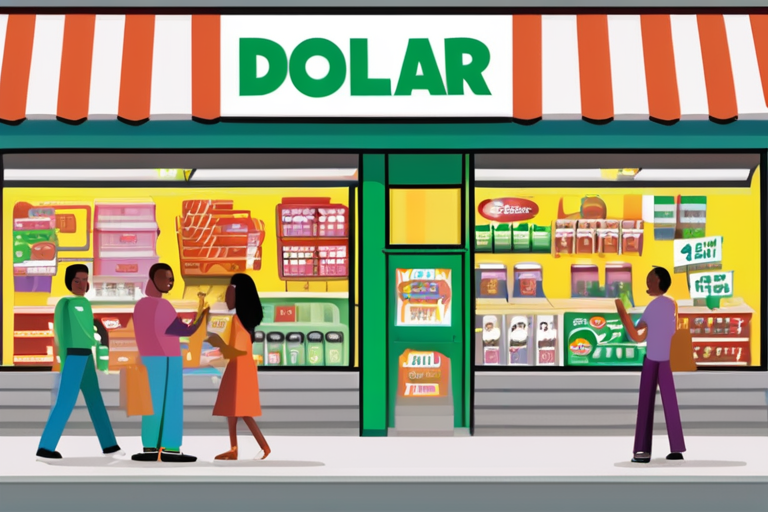
Shares of Dollar Tree and Dollar General, two of the largest dollar-store chains in the United States, have seen significant growth in recent quarters, with a notable increase in customers from higher-income households. According to Dollar Tree's third-quarter earnings report, approximately 60 of the 3 million new households that shopped its stores came from households earning more than $100,000 a year. This trend underscores a deepening split in the American economy, where cumulative inflation has pushed prices up roughly 25% since 2020, while wage growth has not kept pace for most households.
Dollar Tree CEO Michael Creedon Jr. noted that higher-income households are trading into Dollar Tree, while lower-income households are depending on the discount retailer more than ever. "We're seeing a bifurcation in our customer base," Creedon said in a statement to analysts. "Higher-income households are trading into Dollar Tree, while lower-income households are depending on us more than ever." The Virginia-based chain reported same-store sales growth of 4.2% during the quarter, with 85% of sales priced at $2 or less.
Dollar General, the nation's largest dollar-store chain with nearly 21,000 locations, reported similar dynamics in its own earnings report. CEO Todd Vasos noted disproportionate growth coming from higher-income households in the third quarter, as same-store sales rose 2.5% on a 2.5% increase in customer traffic. The company's net profit climbed 44% to $282.7 million.
The trend of higher-income households shopping at dollar stores is not unique to Dollar Tree and Dollar General. According to a report by the market research firm, Statista, the dollar store market in the United States has seen significant growth in recent years, with sales projected to reach $53.4 billion by 2025. This growth is driven in part by the increasing number of households struggling to make ends meet, as well as the rise of online shopping and the need for convenient, affordable retail options.
Experts attribute the trend to a combination of factors, including the widening wealth gap and the decline of the middle class. "The dollar store phenomenon is a symptom of a larger issue," said Dr. Christine Lagarde, a leading economist and former head of the International Monetary Fund. "As wages stagnate and inequality grows, more and more households are turning to discount retailers as a way to make ends meet."
As the economy continues to navigate the challenges of inflation and stagnant wage growth, dollar stores are likely to remain a popular destination for consumers seeking affordable goods and services. With their focus on low prices and convenient shopping experiences, dollar stores are well-positioned to capitalize on the growing demand for discount retail options.
In the coming months, investors and analysts will be closely watching the performance of dollar store chains, including Dollar Tree and Dollar General, as they navigate the challenges and opportunities presented by the changing retail landscape. With their commitment to low prices and convenient shopping experiences, dollar stores are likely to remain a key player in the retail industry for years to come.
Higher-Income Shoppers Flock to Dollar Stores Amid Affordability Crisis
1
0
Multi-Source Journalism
This article synthesizes reporting from multiple credible news sources to provide comprehensive, balanced coverage.
















Share & Engage Share
Share this article