

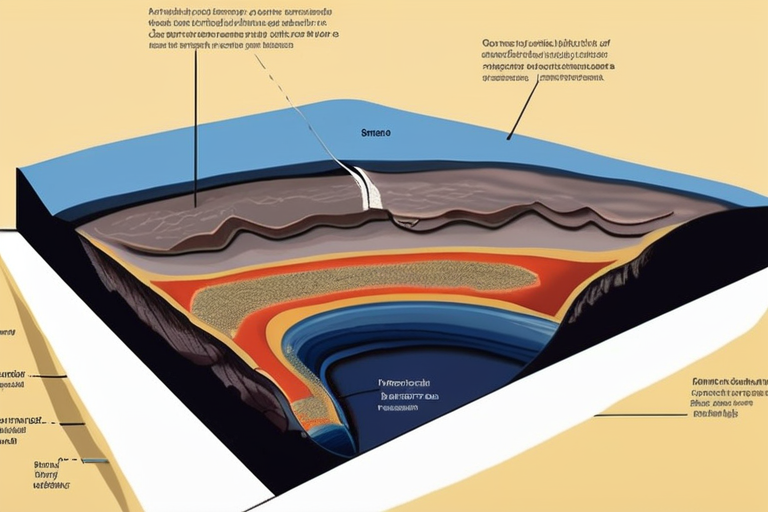
The study, which utilized advanced simulations and analysis of ancient melt inclusions, suggests that the Hadean Eon, which spanned from 4.6 to 4.0 billion years ago, was not a stagnant period as previously believed. Instead, the research indicates that the Earth's crust was experiencing intense subduction, a process where one tectonic plate is forced beneath another.
"This is a game-changer for our understanding of the early Earth," said Dr. A. Vezinet, lead author of the study. "Our findings show that the Hadean Earth was far more dynamic than we ever thought possible, with continents forming and the crust being recycled in a way that challenges our current understanding of plate tectonics."
The discovery was made possible through the analysis of olivine cumulates from the Weltevreden Formation, which contain preserved unaltered olivine cores. These ancient crystals provided valuable insights into the Earth's early history, revealing a planet that was already experiencing intense geological activity.
The Hadean Eon is one of the least understood periods in Earth's past, and the new research sheds light on a critical phase in the planet's development. The findings have significant implications for our understanding of the Earth's evolution and the processes that shaped our planet.
"This study highlights the importance of continued research into the Earth's early history," said Dr. Vezinet. "By studying the ancient rocks and crystals, we can gain a deeper understanding of the processes that shaped our planet and inform our understanding of the Earth's evolution."
The research has also sparked interest in the potential applications of this new understanding of the early Earth. "The implications of this study are far-reaching and could have significant impacts on our understanding of geological processes and the Earth's evolution," said Dr. Vezinet. "This research could also inform our understanding of the Earth's climate and the potential for life on other planets."
The study's findings have been published in Nature Communications and are expected to spark further research into the Earth's early history. As scientists continue to explore the mysteries of the Hadean Eon, this new understanding of the early Earth is set to revolutionize our understanding of the planet's evolution and the processes that shaped our world.
The research team is already planning further studies to build on these findings and gain a deeper understanding of the Earth's early history. "This is just the beginning of a new era of research into the Earth's early history," said Dr. Vezinet. "We are excited to see where this research will take us and what new discoveries we will make."
Early Earth's Hidden Fury: 3.3 Billion-Year-Old Crystals Reveal Turbulent Crust
1
0
Multi-Source Journalism
This article synthesizes reporting from multiple credible news sources to provide comprehensive, balanced coverage.


















Share & Engage Share
Share this article