

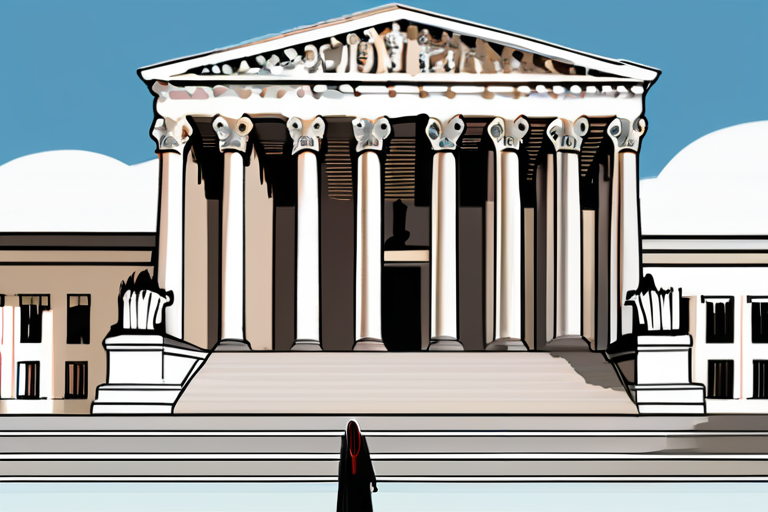
The Supreme Court has agreed to take up a case involving President Donald Trump's executive order that aimed to end birthright citizenship, a move that has been widely criticized as unconstitutional. The court's decision to hear the case comes after a federal judge in January blocked the order, citing the clear language of the 14th Amendment to the Constitution.
In a statement, Judge John Coughenour, who blocked the order, said, "I've been on the bench for over four decades, and I can't remember another case where the question presented is as clear as this one is." Coughenour's ruling was part of a growing trend of judges rejecting Trump's attempt to end birthright citizenship, with numerous other judges following suit in the months that followed.
The issue at the heart of the case is the interpretation of the 14th Amendment, which states that "all persons born or naturalized in the United States, and subject to the jurisdiction thereof, are citizens of the United States and of the State wherein they reside." Trump's executive order, issued in January, claimed that the amendment did not apply to children born to undocumented immigrants, but this interpretation has been widely disputed by legal experts and judges.
Critics of Trump's order argue that it would have a disproportionate impact on immigrant communities, particularly those with mixed-status families. "This is a clear attempt to undermine the rights of immigrant families and to create a two-tiered system of citizenship," said Maria Rodriguez, a lawyer with the American Civil Liberties Union. "We will continue to fight against this unconstitutional order and ensure that the rights of all individuals are protected."
Supporters of Trump's order argue that it is necessary to address the issue of undocumented immigration and to ensure that only those who are lawfully present in the country are eligible for citizenship. "We believe that the 14th Amendment should be interpreted in a way that is consistent with the intent of the framers," said a spokesperson for the Trump administration. "This means that only those who are subject to the jurisdiction of the United States should be considered citizens."
The Supreme Court's decision to hear the case is a significant development, as it will provide a final say on the constitutionality of Trump's executive order. The court's ruling is expected to have far-reaching implications for immigrant communities and the interpretation of the 14th Amendment.
The case is currently scheduled to be heard in the coming months, with a decision expected in the spring of 2026. In the meantime, advocates on both sides of the issue will continue to push for their respective positions, with the outcome hanging in the balance.
Supreme Court to Review Trump's Challenged Birthright Citizenship Order
1
0
Multi-Source Journalism
This article synthesizes reporting from multiple credible news sources to provide comprehensive, balanced coverage.
















Share & Engage Share
Share this article