

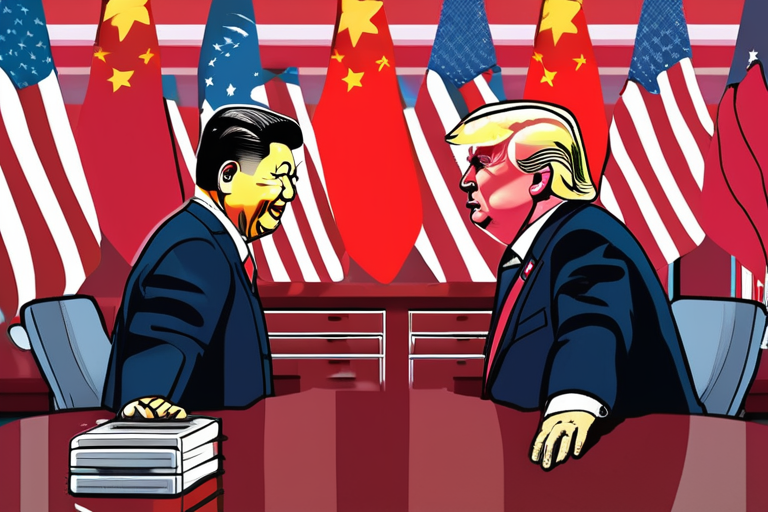
Willett Advisors' Steven Rattner expressed concerns that the United States cannot out-negotiate China in a recent appearance on Bloomberg TV's Wall Street Week. Rattner, who returned from China, shared his views on the country's economy, which he described as running at two speeds, with weak consumption but booming tech sectors.
According to Rattner, China is overtaking the US in electric vehicles, biotech, and AI, with significant investments in these areas. He noted that tariffs are unlikely to stop China's momentum, citing the country's ability to absorb the costs and continue to drive innovation. Rattner emphasized that the US must compete through innovation and smart policy at home, rather than trying to slow China down.
Rattner's comments come as China continues to make strides in the tech sector, with investments in electric vehicles reaching $100 billion in 2025, according to a report by BloombergNEF. China's biotech sector has also seen significant growth, with the country accounting for over 30% of global biotech investments in 2024, according to a report by Deloitte. In AI, China has made significant advancements, with the country's AI research output surpassing that of the US in 2023, according to a report by the AI Now Institute.
Rattner's views on China's economy are supported by recent data, which shows that China's GDP growth has surpassed that of the US, with the country's economy expanding by 6.5% in 2024, compared to the US's 2.5% growth rate. China's consumer spending, however, remains weak, with the country's retail sales growth slowing to 3.5% in 2024, down from 6.5% in 2023.
Industry experts have long warned that China's growing tech sector poses a significant challenge to the US, with many companies, including electric vehicle manufacturers and biotech firms, shifting their focus to the Chinese market. Rattner's comments highlight the need for the US to adapt and innovate in order to remain competitive in the global economy.
As the US and China continue to engage in a trade war, Rattner's views offer a nuanced perspective on the challenges facing the US in the tech sector. While tariffs may not be effective in slowing China's momentum, Rattner's emphasis on innovation and smart policy at home suggests that the US can still compete effectively in the global economy.
The current status of the US-China trade relationship remains uncertain, with ongoing negotiations between the two countries. However, Rattner's comments suggest that the US must take a long-term view and focus on developing its own tech sector in order to remain competitive in the global economy.
US Fails to Outmaneuver China in Trade Talks, Warns Economic Expert
1
0
Multi-Source Journalism
This article synthesizes reporting from multiple credible news sources to provide comprehensive, balanced coverage.









Share & Engage Share
Share this article