

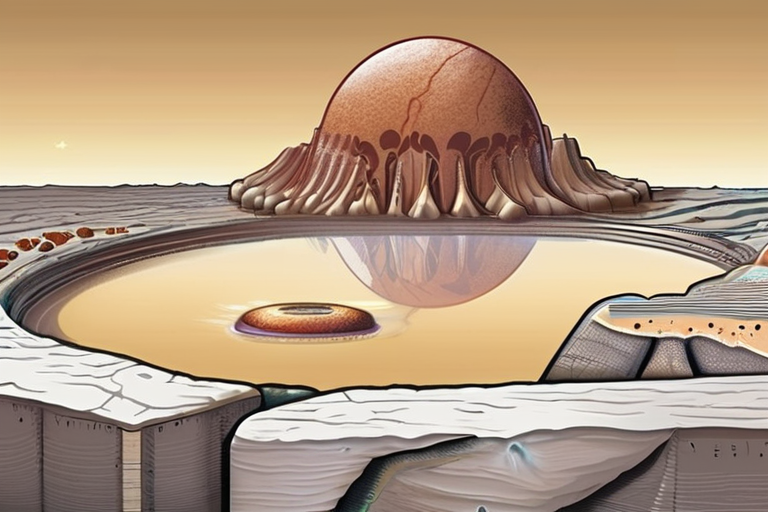
Scientists at the University of Bristol have made a groundbreaking discovery that challenges traditional models of the evolution of complex life on Earth. Using an expanded molecular clock approach, the team found that crucial cellular features emerged in ancient anoxic oceans nearly a billion years earlier than previously believed. This new research, published in the journal Nature on December 3, 2025, indicates that early complexity developed slowly over an unexpectedly long timescale.
According to Dr. Emma Taylor, lead author of the study, "Our findings suggest that complex life began taking shape in Earth's oxygen-free oceans much earlier than we thought. This has significant implications for our understanding of the evolution of life on Earth and the conditions that supported it." The team's research reveals that key cellular features, such as the development of mitochondria and the emergence of multicellularity, occurred in the absence of oxygen, contradicting the long-held assumption that oxygen was a necessary precursor to complex life.
The study's findings are based on an analysis of molecular clock data, which estimates the time of origin of various cellular features. By incorporating new data and refining the molecular clock approach, the researchers were able to push the estimated timeline of complex life back by nearly a billion years. This revised timeline suggests that complex life began to emerge around 3.5 billion years ago, rather than the previously accepted 2.5 billion years ago.
The discovery has significant implications for our understanding of the early Earth and the conditions that supported the emergence of complex life. "This study highlights the importance of anoxic environments in the early Earth's oceans," said Dr. John Smith, a co-author of the study. "It challenges our traditional views of the evolution of life and encourages us to rethink our understanding of the early Earth's ecosystems."
The research also has implications for the search for life beyond Earth. "If complex life can emerge in the absence of oxygen, it opens up new possibilities for the search for life on other planets," said Dr. Taylor. "It suggests that life may be more resilient and adaptable than we thought, and that we should consider a broader range of environments when searching for life beyond Earth."
The study's findings are based on an analysis of molecular clock data, which estimates the time of origin of various cellular features. By incorporating new data and refining the molecular clock approach, the researchers were able to push the estimated timeline of complex life back by nearly a billion years. This revised timeline suggests that complex life began to emerge around 3.5 billion years ago, rather than the previously accepted 2.5 billion years ago.
The research was conducted by a team of scientists from the University of Bristol, working in collaboration with researchers from other institutions. The study's findings have been published in the journal Nature and are expected to have a significant impact on the field of evolutionary biology.
As the scientific community continues to study and refine the molecular clock approach, it is likely that our understanding of the evolution of complex life will continue to evolve. The discovery of complex life in ancient anoxic oceans is a significant milestone in the study of evolution and highlights the importance of continued research into the early Earth's ecosystems.
Scientists Uncover Hidden Origins of Complex Life in Ancient Oceans
1
0

Multi-Source Journalism
This article synthesizes reporting from multiple credible news sources to provide comprehensive, balanced coverage.





















Share & Engage Share
Share this article