

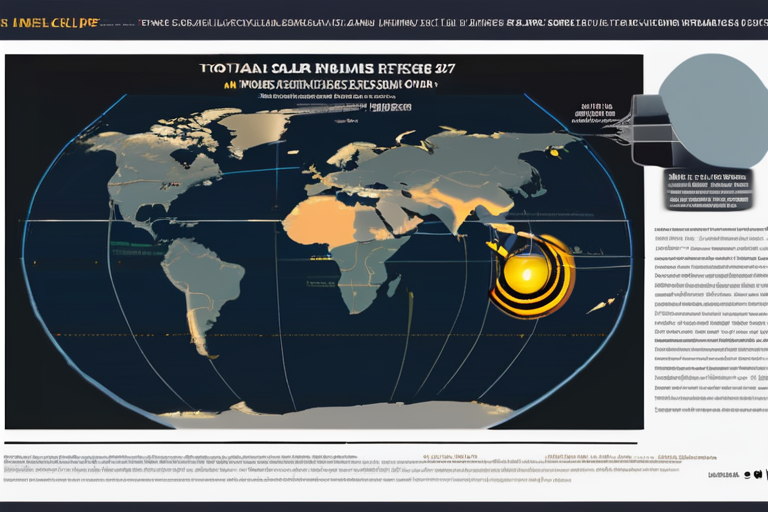
NASA's solar eclipse calendar indicates that the longest total solar eclipse in 100 years will occur on August 2, 2027, with a total phase lasting 6 minutes and 23 seconds. The eclipse will begin in Morocco and southern Spain, then advance through Algeria, Tunisia, Libya, Egypt, and Saudi Arabia, culminating in Yemen and the coast of Somalia. Its maximum duration will be recorded in Egypt, specifically in Luxor and Aswan, famous for their funerary temples.
According to Dr. Maria Rodriguez, a NASA expert on solar eclipses, "This event will be a rare opportunity for scientists to study the sun's corona, which is the outer atmosphere of the sun. The longer duration of the eclipse will allow us to collect more data and gain a deeper understanding of the sun's behavior." Dr. Rodriguez added that the eclipse will also provide a unique opportunity for the public to witness a rare astronomical event.
The path of the eclipse will cover regions of Europe, North Africa, and the Middle East, affecting millions of people. While some may view the eclipse as a spectacle, others may be concerned about its potential impact on daily life. However, experts assure that solar eclipses do not have any physical impact on the planet and do not affect human health.
In comparison, the total solar eclipse that crossed North America in April 2024 lasted 4 minutes and 28 seconds, while the one that will reach Spain in August 2026 will only last 1 minute and 43 seconds. These events demonstrate the variability of solar eclipses, which are influenced by the moon's orbit and the sun's position in the sky.
Solar eclipses have been a subject of fascination for centuries, with many cultures viewing them as omens or signs of significant events. However, modern science has dispelled these myths, revealing the eclipse as a natural phenomenon governed by celestial mechanics. As Dr. Rodriguez noted, "Solar eclipses are a reminder of the awe-inspiring beauty and complexity of the universe, and we are fortunate to have the opportunity to study and appreciate them."
The current status of the eclipse is that it is still over a year away, and scientists are preparing for the event by conducting research and developing new technologies to study the sun's corona. The next developments will include further research and observations of the eclipse, as well as educational programs to raise awareness about the event and its significance.
In conclusion, the longest total solar eclipse in 100 years is a rare and significant event that will provide scientists with a unique opportunity to study the sun's behavior and the public with a chance to witness a spectacular astronomical event.
Total Solar Eclipse 2027: A Rare 6-Minute Phenomenon Across North Africa
1
0
Multi-Source Journalism
This article synthesizes reporting from multiple credible news sources to provide comprehensive, balanced coverage.






























Share & Engage Share
Share this article