

The study, led by T. Maavara and published in Nature Rev. Earth Environ. in 2020, found that reservoirs can alter water temperature, sediment transport, and nutrient transport, ultimately affecting global biogeochemical and ecological processes. To address this issue, researchers are calling for the development of more advanced models that can accurately simulate the complex interactions between reservoirs and their surrounding ecosystems.
"We need to develop more sophisticated models that can capture the intricate relationships between reservoirs and their ecosystems," said Dr. Maria Rodriguez, a researcher at the University of California, Berkeley. "This will enable us to better predict and mitigate the ecological impacts of reservoirs, ultimately benefiting both the environment and human communities."
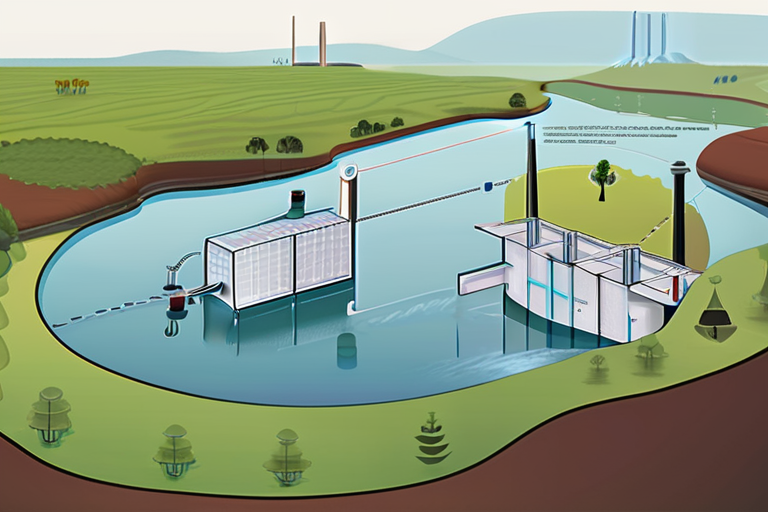
The development of more accurate models is crucial, as reservoirs are a ubiquitous feature of modern water management systems. According to the study, reservoirs can affect water flow, sediment transport, and greenhouse-gas emissions in large rivers worldwide, with significant implications for global biogeochemical and ecological processes.
The need for better models is also driven by the increasing demand for water resources, which has led to the construction of more reservoirs worldwide. As the global population continues to grow, the pressure on water resources is expected to intensify, making it essential to develop more accurate models to predict and mitigate the ecological impacts of reservoirs.
In addition to the development of more advanced models, researchers are also exploring the use of artificial intelligence (AI) and machine learning (ML) techniques to improve the accuracy of reservoir modeling. These techniques can help researchers to identify complex patterns and relationships in large datasets, ultimately enabling them to develop more accurate models of reservoir behavior.
The use of AI and ML in reservoir modeling is still in its early stages, but researchers are optimistic about its potential to improve the accuracy of reservoir modeling. "AI and ML have the potential to revolutionize reservoir modeling by enabling us to develop more accurate and sophisticated models," said Dr. John Lee, a researcher at the University of Michigan. "This will ultimately benefit both the environment and human communities by enabling us to better predict and mitigate the ecological impacts of reservoirs."
As researchers continue to develop more accurate models of reservoir behavior, they are also working to improve our understanding of the complex interactions between reservoirs and their surrounding ecosystems. This research has significant implications for society, as it can inform decision-making on water resource management, ecosystem conservation, and climate change mitigation.
In conclusion, the need for more accurate and sophisticated models to assess the ecological impacts of reservoirs is clear. By developing better models and exploring the use of AI and ML techniques, researchers can improve our understanding of the complex interactions between reservoirs and their surrounding ecosystems, ultimately benefiting both the environment and human communities.
Reservoirs' Hidden Impact: Better Models Needed to Understand Ecological Consequences
1
0
Multi-Source Journalism
This article synthesizes reporting from multiple credible news sources to provide comprehensive, balanced coverage.




























Share & Engage Share
Share this article