

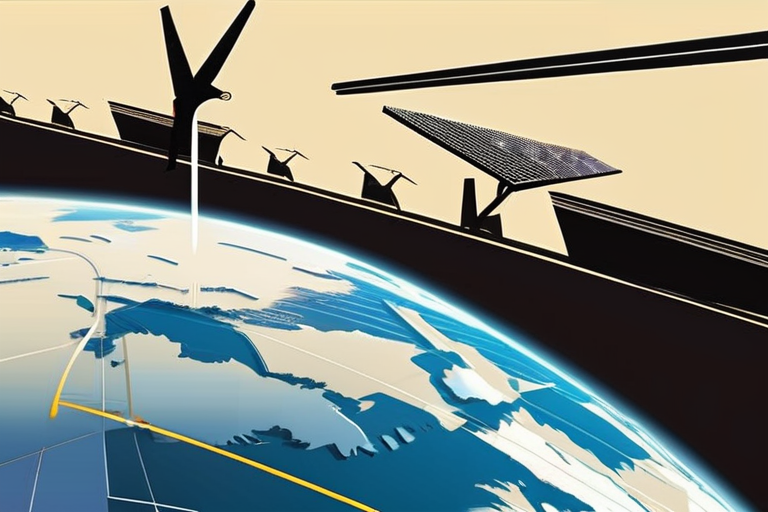
Shares of the Israeli-based startup Stardust Solutions have been gaining attention in recent weeks as the company announces its ambitious plan to tackle climate change through geoengineering. The proposal involves launching specially equipped aircraft into the stratosphere to disperse particles that reflect away enough sunlight to cool down the planet, a process that the company claims will not cause any environmental side effects. According to Stardust Solutions, it expects to receive more than a billion dollars a year from nations to carry out this global deployment in the next decade.
Industry experts and solar geoengineering researchers, however, have expressed skepticism about Stardust Solutions' plan. Dr. Kate Ricke, a researcher at the University of California, Berkeley, who has studied the effects of solar geoengineering, stated that "the idea of a private company setting the global temperature for us is highly problematic." Ricke added that "there is still a lot of uncertainty about the potential environmental impacts of solar geoengineering, and we need more research before we can consider it as a viable solution to climate change."
The concept of geoengineering, which involves large-scale technological interventions in the Earth's climate system, has been gaining attention in recent years as a potential solution to mitigate the effects of climate change. However, experts warn that it is still a highly experimental and untested technology, and its potential consequences are not yet fully understood. "Geoengineering is a complex and multifaceted issue that requires careful consideration and coordination among governments, scientists, and industry stakeholders," said Dr. David Keith, a professor at Harvard University and a leading expert on geoengineering.
Stardust Solutions' proposal is part of a broader trend of private companies taking on the challenge of addressing climate change. The company's CEO, Rachel Cohen, stated that "we believe that our technology has the potential to make a significant impact on the global climate crisis, and we are committed to working with governments and other stakeholders to make it a reality." However, the company's plan has also raised concerns about the potential for unequal distribution of benefits and costs, as well as the lack of transparency and accountability in the decision-making process.
As the debate around geoengineering continues, it remains to be seen whether Stardust Solutions' proposal will gain traction and become a viable solution to climate change. The company has announced plans to begin testing its technology in the near future, but it is unclear whether it will be able to secure the necessary funding and support to carry out its ambitious plan.
Startup Tackles Climate Change with Ambitious Stratospheric Intervention
1
0

Multi-Source Journalism
This article synthesizes reporting from multiple credible news sources to provide comprehensive, balanced coverage.
























Share & Engage Share
Share this article