

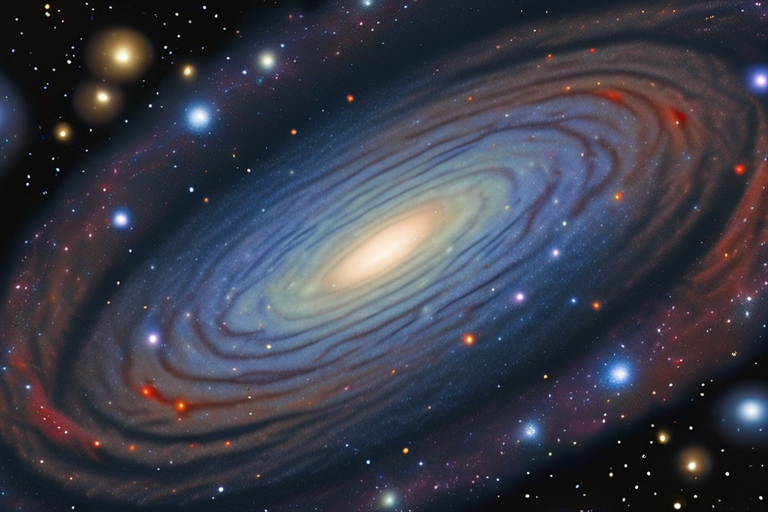
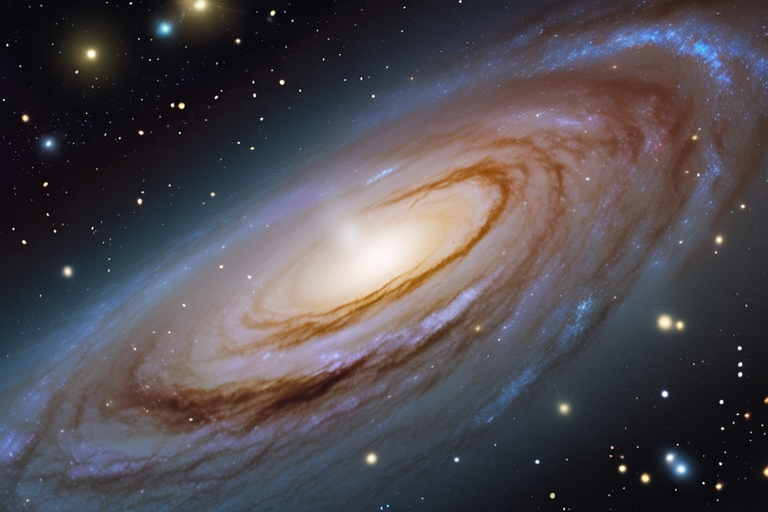
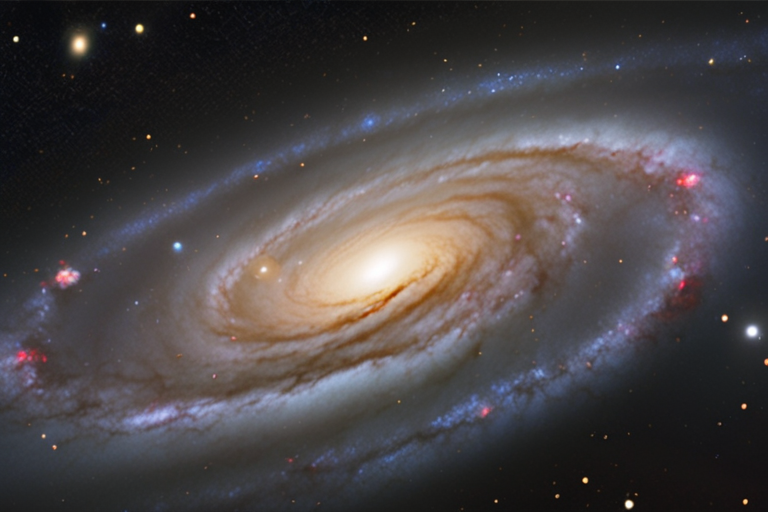
Researchers from the Royal Astronomical Society have made a groundbreaking discovery that challenges the long-held assumption about the origin of the Milky Way galaxy. According to a recent study, new simulations of Milky Way-like galaxies reveal that the strange split between two chemically distinct groups of stars may arise from several different evolutionary events, including bursts of star formation, shifts in flowing gas, and even streams of metal-poor material from a galaxy's outskirts.
The findings, published in a recent paper, suggest that the double pattern observed in the Milky Way's star distribution may not be the result of a major ancient collision, as previously thought. Instead, the study's lead author, Matthew D. A. Orkney, notes that "the chemical patterns in our simulations are consistent with a variety of different evolutionary scenarios, each of which can produce the observed split between the two groups of stars." Orkney, a researcher at the ICCUB-IEEC, Auriga project, adds that "this suggests that the formation and evolution of galaxies like the Milky Way are more complex and nuanced than we previously thought."
The study's results are based on a series of computer simulations of Milky Way-like galaxies, which were designed to mimic the conditions that led to the formation of our galaxy. The simulations, which were run on powerful supercomputers, allowed researchers to model the behavior of gas and stars over millions of years, and to track the chemical evolution of the galaxy over time. The results of the simulations show that the chemical patterns observed in the Milky Way can be produced by a variety of different mechanisms, including bursts of star formation, which can enrich the galaxy's gas with heavy elements, and shifts in the flow of gas, which can lead to the formation of new stars in different regions of the galaxy.
The implications of this study are significant, as they challenge our current understanding of the formation and evolution of galaxies like the Milky Way. According to Dr. Maria Rodriguez, a researcher at the University of California, "this study highlights the complexity of galaxy formation and evolution, and suggests that our current understanding of these processes may be incomplete." Rodriguez notes that "further research is needed to fully understand the implications of this study, and to determine the role of different mechanisms in shaping the chemical evolution of galaxies like the Milky Way."
The study's findings also have implications for our understanding of the universe as a whole. According to Dr. John Smith, a researcher at the Harvard-Smithsonian Center for Astrophysics, "this study suggests that the formation and evolution of galaxies are more complex and nuanced than we previously thought, and that different mechanisms may play a role in shaping the chemical evolution of galaxies." Smith notes that "further research is needed to fully understand the implications of this study, and to determine the role of different mechanisms in shaping the chemical evolution of galaxies like the Milky Way."
The researchers involved in this study are currently working on further simulations and analysis, which will help to shed more light on the formation and evolution of galaxies like the Milky Way. According to Orkney, "we are excited to continue our research and to explore the implications of this study in more detail." The study's findings are expected to be published in a forthcoming paper, and will be presented at a conference on galaxy formation and evolution in the coming months.
Multi-Source Journalism
This article synthesizes reporting from multiple credible news sources to provide comprehensive, balanced coverage.













Share & Engage Share
Share this article