

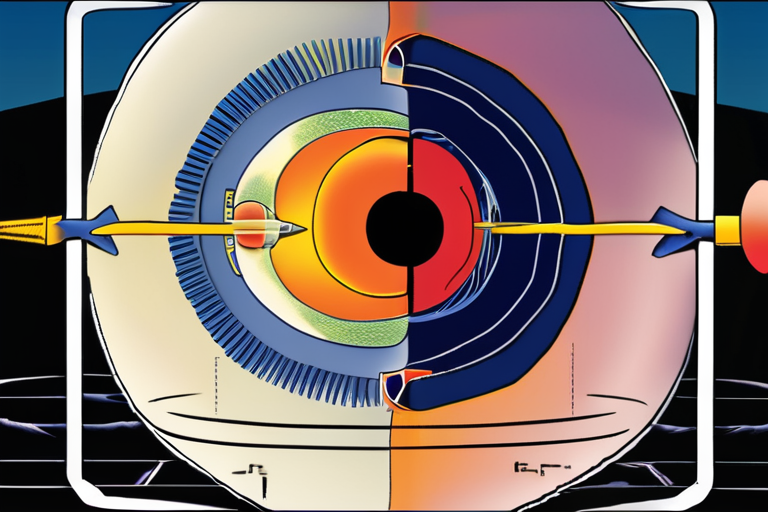
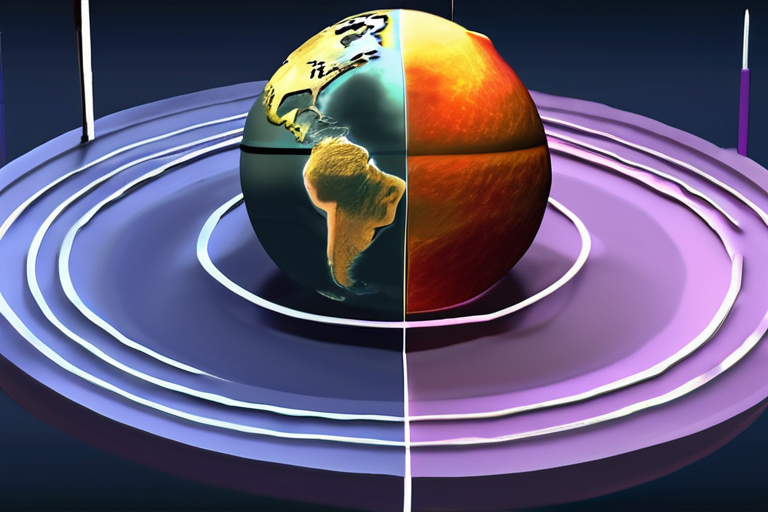
Scientists have discovered that Earth's inner core behaves like a superionic solid, with carbon atoms moving fluid-like through solid iron. This breakthrough explains strange seismic signals and offers fresh insight into how Earth's magnetic field is powered. According to a recent study published in Science China Press, researchers found that the inner core is not a solid, rigid structure as previously thought, but rather a dynamic system where carbon atoms flow freely through a solid iron lattice.
The study's lead author, Dr. Li Ming, a geophysicist at the University of Science and Technology of China, explained that the discovery was made possible by advanced computational simulations and laboratory experiments. "We used a combination of numerical modeling and laboratory experiments to simulate the behavior of the inner core under high pressure and temperature conditions," Dr. Li said. "Our results showed that the inner core is in a superionic state, where carbon atoms are able to move freely through the solid iron lattice."
This unusual behavior makes the core soft, matching seismic observations that have puzzled scientists for decades. The mobility of these light elements may also contribute energy to Earth's magnetic field. The findings reshape models of Earth's interior and could apply to other rocky planets. Dr. Li noted that the discovery has significant implications for our understanding of the Earth's magnetic field, which is powered by the movement of molten iron in the outer core. "The magnetic field is essential for life on Earth, and understanding how it is generated is crucial for predicting and mitigating the effects of space weather," Dr. Li said.
The discovery of the superionic state of the inner core is a significant breakthrough in the field of geophysics. It challenges the long-held assumption that the inner core is a solid, rigid structure and provides new insights into the dynamics of the Earth's interior. The study's findings have important implications for our understanding of the Earth's magnetic field and its role in protecting life on Earth.
The research team used advanced computational simulations and laboratory experiments to study the behavior of the inner core. They found that the inner core is composed of a mixture of iron and light elements, including carbon, which are able to move freely through the solid iron lattice. This mobility of the light elements is thought to contribute to the softening of the inner core and the generation of the Earth's magnetic field.
The study's findings have significant implications for our understanding of the Earth's interior and its role in powering the magnetic field. The research team's discovery of the superionic state of the inner core is a major breakthrough in the field of geophysics and has the potential to revolutionize our understanding of the Earth's magnetic field and its role in protecting life on Earth.
In an interview, Dr. Li emphasized the importance of continued research in this area. "This discovery is just the beginning of a new era of research into the Earth's interior," Dr. Li said. "We need to continue studying the behavior of the inner core and its role in powering the magnetic field to better understand the complex dynamics of the Earth's interior."
The study's findings have been met with excitement and interest in the scientific community. Dr. John T. Wasson, a geophysicist at the University of California, Los Angeles, noted that the discovery is a significant breakthrough in the field of geophysics. "This study provides new insights into the dynamics of the Earth's interior and challenges our long-held assumptions about the inner core," Dr. Wasson said.
The research team's discovery of the superionic state of the inner core is a major breakthrough in the field of geophysics and has significant implications for our understanding of the Earth's magnetic field and its role in protecting life on Earth. The study's findings have the potential to revolutionize our understanding of the Earth's interior and its role in powering the magnetic field.
Earth's Inner Core Unveiled: Scientists Discover Superionic Solid Behavior
1
0
Multi-Source Journalism
This article synthesizes reporting from multiple credible news sources to provide comprehensive, balanced coverage.




















Share & Engage Share
Share this article