

Breaking News: Laos's National Herpetologist Pioneers Conservation Efforts
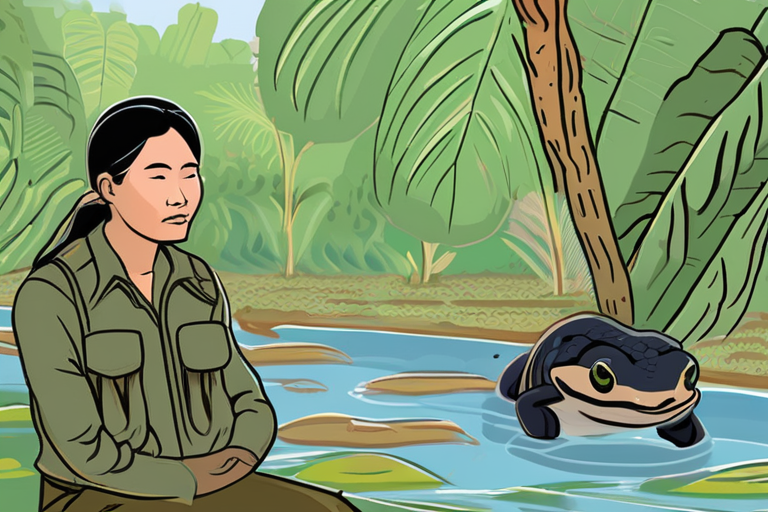
In a groundbreaking achievement, Somphouthone Phimmachak, Laos's national herpetologist, has made significant strides in conservation efforts by focusing on the country's threatened amphibian and reptile species. As one of the few specialists in Laos, Phimmachak's work has shed light on the diversity of Tylototriton salamanders, leading to the discovery of four new species. This milestone marks a turning point in the country's conservation history, as Phimmachak's research has challenged the trend of foreign scientists dominating conservation studies in Laos.
Phimmachak's day-to-day responsibilities at the National University of Laos in Vientiane include giving lectures, conducting research, leading studies, training future biologists, and contributing to conservation initiatives. Her own research has been ongoing since 2007, when she started her master's degree, and culminated in her PhD, which focused on the diversity of Tylototriton salamanders. In a recent field survey, Phimmachak recorded the number of adults, tadpoles, and eggs of Fejervarya limnocharis frogs along a stream outside Vientiane.
The immediate impact of Phimmachak's work is evident in the growing awareness and concern for Laos's threatened species. Her research has sparked a national conversation about the importance of conservation and the need for local expertise in addressing the country's unique biodiversity challenges. The Lao government has taken notice, with plans to establish a national conservation strategy that incorporates Phimmachak's findings.
Laos's rich cultural heritage and biodiversity have long been threatened by habitat destruction, overhunting, and climate change. The country's unique geography, with its lush forests and vast wetlands, has made it a hotspot for species discovery. However, the lack of local expertise in conservation has hindered efforts to protect these species. Phimmachak's pioneering work has bridged this gap, providing a much-needed voice for Laos's animals.
As Phimmachak continues her research and advocacy, the international community is taking notice. Her work has implications for global conservation efforts, highlighting the importance of local expertise and community engagement in protecting threatened species. The United Nations Development Programme (UNDP) has expressed interest in collaborating with Phimmachak on future conservation initiatives, recognizing the potential for her research to inform global conservation policies.
With Phimmachak at the helm, Laos is poised to become a leader in regional conservation efforts. Her groundbreaking research and advocacy have paved the way for a new era of conservation in the country, one that prioritizes local expertise and community engagement. As the world watches, Phimmachak's work serves as a powerful reminder of the importance of giving a voice to animals and the people who care for them.
Laos's National Herpetologist Leads Charge in Amphibian and Reptile Conservation
1
0
Multi-Source Journalism
This article synthesizes reporting from multiple credible news sources to provide comprehensive, balanced coverage.



















Share & Engage Share
Share this article