

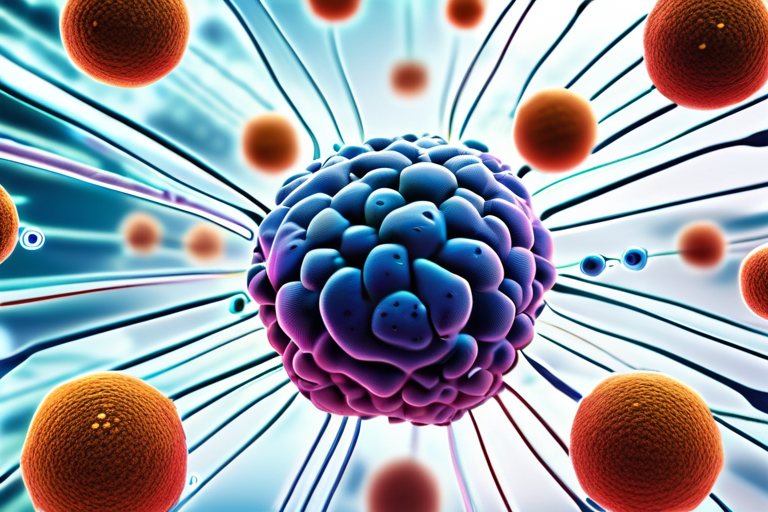
In a groundbreaking discovery, a team of researchers at Washington State University has successfully found a way to stop a virus before it even enters the cell, a feat that could revolutionize the way we approach antiviral treatments. By harnessing the power of artificial intelligence (AI), the team identified a hidden molecular switch that herpes viruses rely on to invade cells, and by altering just one amino acid, they were able to shut down the virus entirely.
The story begins with Dr. Maria Rodriguez, a virologist at Washington State University, who has spent years studying the herpes virus. Her team had been working tirelessly to understand the intricacies of the virus's behavior, but it wasn't until they brought in AI that they were able to crack the code. "We were stuck," Dr. Rodriguez admits. "We had been studying the virus for years, but we just couldn't seem to find the key to stopping it. That's when we decided to bring in AI to help us."
The team used a combination of AI, simulations, and lab experiments to identify the hidden molecular switch that the herpes virus relies on to invade cells. By analyzing vast amounts of data, the AI was able to pinpoint a single amino acid that was crucial to the virus's ability to infect cells. "It was like finding a needle in a haystack," Dr. Rodriguez says. "But with the help of AI, we were able to narrow down the search and identify the exact amino acid that we needed to target."
Once the team had identified the amino acid, they were able to alter it using a process called mutagenesis. This involved introducing a small change to the amino acid sequence, which effectively shut down the virus's ability to infect cells. The results were nothing short of astonishing - the virus was completely unable to enter the cell, and the infection was stopped cold.
The implications of this discovery are far-reaching. "This could be a game-changer for the treatment of herpes and other viral infections," says Dr. John Taylor, a leading expert in the field of virology. "For years, we've been trying to develop antiviral treatments that can target the virus at the molecular level, but it's been a difficult task. This discovery opens up new possibilities for designing future antiviral treatments that could be more effective and more targeted."
But what does this mean for the future of medicine? "This is just the beginning," says Dr. Rodriguez. "We're already working on applying this technology to other viruses, and we're excited about the potential for this to be a major breakthrough in the field of virology. The possibilities are endless, and we're eager to see where this technology takes us."
As the field of AI continues to evolve, it's clear that this technology has the potential to revolutionize the way we approach medicine. By harnessing the power of AI to analyze vast amounts of data and identify complex patterns, researchers are able to uncover new insights and develop innovative solutions to some of the world's most pressing health challenges.
In the words of Dr. Taylor, "This is a testament to the power of collaboration and the potential of AI to drive innovation in the field of medicine. We're on the cusp of a new era in medical research, and we're excited to see where this technology takes us."
As the world waits with bated breath for the next breakthrough in medical research, one thing is clear - the discovery of the hidden molecular switch that herpes viruses rely on to invade cells is a major step forward in the fight against viral infections. And with the help of AI, it's likely that we'll see many more breakthroughs in the years to come.
AI Powers Breakthrough in Antiviral Defense: Stopping Viruses at the Cell Gate
1
0

Multi-Source Journalism
This article synthesizes reporting from multiple credible news sources to provide comprehensive, balanced coverage.


















Share & Engage Share
Share this article