

Researchers at the University of Tokyo have developed a new timing-based method to determine the formation of hot Jupiters, a class of gas giants that orbit their stars in extremely close proximity. According to the study, published on December 15, 2025, the time needed for a planet's orbit to circularize can reveal whether it was formed through violent gravitational encounters or peaceful drift through its birth disk.
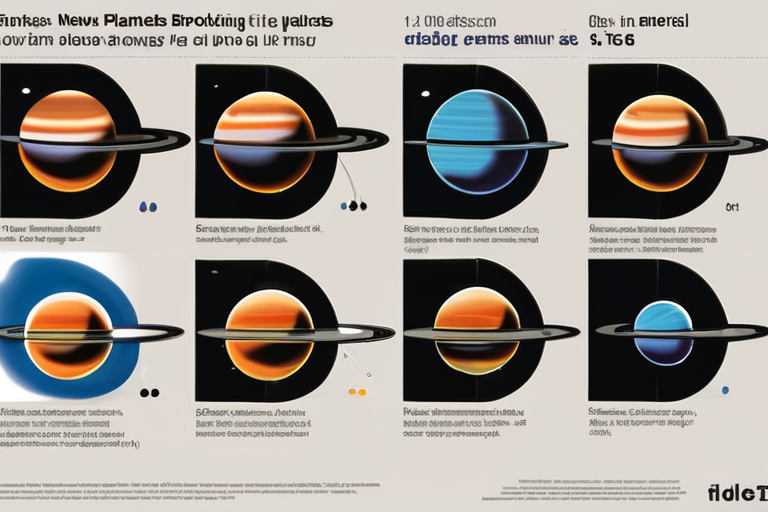
The researchers used this approach to analyze the orbital characteristics of several hot Jupiters, finding that those that formed through peaceful drift had longer timescales for orbital circularization. This suggests that these planets were able to migrate inward through the disk without experiencing violent gravitational interactions with other bodies. In contrast, hot Jupiters that formed through violent encounters had shorter timescales for orbital circularization, indicating that they were scattered inward through the disk.
Dr. Yui Kawahara, lead author of the study, explained that the new method provides a unique insight into the formation of hot Jupiters. "Our approach allows us to distinguish between peaceful and violent migration scenarios, which was previously impossible," she said. "This has significant implications for our understanding of planetary formation and the evolution of planetary systems."
The discovery of hot Jupiters has long been a topic of interest in the field of exoplanetary science. These planets were once considered cosmic oddities, but researchers have since discovered that they are relatively common in the universe. However, the mechanisms by which they form and migrate to their current orbits have remained a mystery.
The new study provides a significant breakthrough in understanding the formation of hot Jupiters. By analyzing the orbital characteristics of these planets, researchers can gain insight into the conditions under which they formed and the processes that shaped their evolution. This knowledge can have significant implications for our understanding of planetary formation and the search for life beyond Earth.
The study's findings have also sparked interest in the potential for applying this method to other areas of exoplanetary research. "This approach could be used to study the formation of other types of exoplanets, such as super-Earths and mini-Neptunes," said Dr. Kawahara. "By understanding the formation mechanisms of these planets, we can gain a better understanding of the diversity of planetary systems in the universe."
The University of Tokyo researchers plan to continue studying the formation of hot Jupiters and applying their new method to other areas of exoplanetary research. Their findings have significant implications for our understanding of planetary formation and the search for life beyond Earth.
Scientists Uncover Timing Key to Hot Jupiters' Mysterious Formation
1
0
Multi-Source Journalism
This article synthesizes reporting from multiple credible news sources to provide comprehensive, balanced coverage.



























Share & Engage Share
Share this article