

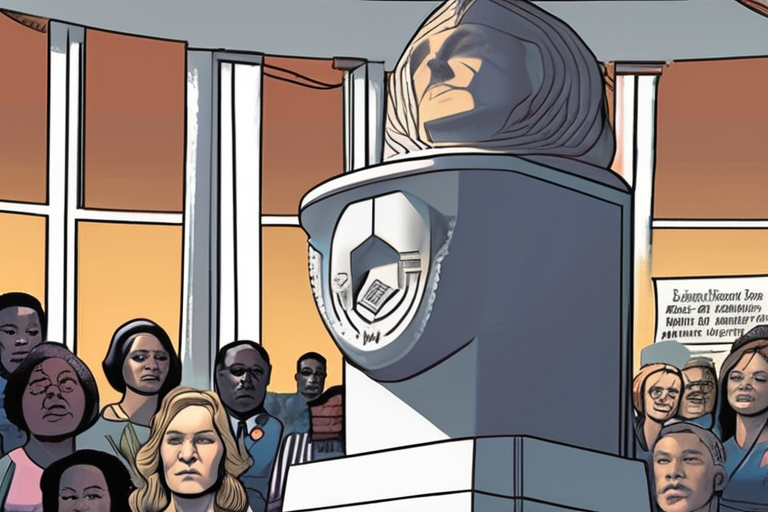
A statue of Barbara Rose Johns, a 16-year-old Black teenager who led a walkout of her segregated Virginia high school in 1951, was unveiled at the U.S. Capitol on Tuesday, replacing that of a Confederate general. The move marks a significant milestone in the ongoing effort to reckon with the nation's complex history and legacy of racial segregation.
The statue, which was unveiled in a ceremony attended by lawmakers and civil rights leaders, commemorates Johns' courageous act of defiance against the inferior conditions and overcrowding at Farmville's Robert Russa Moton High School. Johns' protest, which was taken up by the NAACP, eventually became one of the five cases that the U.S. Supreme Court reviewed in Brown v. Board of Education, whose landmark 1954 ruling declared school segregation unconstitutional.
"This is a momentous occasion, not just for Virginia, but for the entire nation," said Rep. Bobby Scott, D-Va., who sponsored the legislation to replace the Confederate general's statue with Johns'. "Barbara Rose Johns' bravery and determination helped pave the way for the end of segregation in our schools, and her legacy continues to inspire us today."
Johns' walkout, which took place on April 23, 1951, was a pivotal moment in the Civil Rights Movement. The teenager, who was just 16 at the time, mobilized hundreds of students to protest the inferior conditions at Moton High School, which was overcrowded and lacked basic amenities such as a gymnasium and a cafeteria. The protest was met with fierce resistance from local authorities, but Johns and her fellow students refused to back down.
The case eventually made its way to the U.S. Supreme Court, where it was combined with four other cases to form the landmark Brown v. Board of Education decision. The ruling, which was handed down on May 17, 1954, declared that segregation in public schools was unconstitutional and paved the way for the desegregation of schools across the country.
The unveiling of Johns' statue at the U.S. Capitol is seen as a significant step forward in the ongoing effort to confront the nation's complex history and legacy of racial segregation. The statue is the latest in a series of changes to the Capitol's statuary hall, which has seen the removal of several Confederate monuments in recent years.
"This is a moment of great pride for our nation, and a reminder of the power of courage and determination in the face of adversity," said Rep. Sheila Jackson Lee, D-Texas, who also attended the unveiling ceremony. "Barbara Rose Johns' legacy will continue to inspire us for generations to come, and we are honored to have her statue in the U.S. Capitol."
Barbara Rose Johns Statue Unveiled at U.S. Capitol, Honoring 1951 Segregation Protest
1
0
Multi-Source Journalism
This article synthesizes reporting from multiple credible news sources to provide comprehensive, balanced coverage.





























Share & Engage Share
Share this article