

The team's innovative approach leverages the principle of evaporative cooling, where the hotter atoms rise to the top of the magnetic trap and jump out as steam. This process is also responsible for the formation of wine tears, a key step in creating Bose-Einstein condensates, and the cooling effect experienced when cooking meat on a BBQ. By harnessing this phenomenon, the researchers were able to create a miniature ice sculpture at minimal cost.
"We were able to create a stable ice structure without the need for refrigeration equipment or freezing technology," said Dr. [Name], lead researcher on the project. "This achievement has significant implications for the field of materials science and the development of novel cooling technologies." Dr. [Name] attributed the success of the project to the team's ability to fine-tune the evaporative cooling process, allowing them to create a stable ice structure that can withstand ambient temperatures.
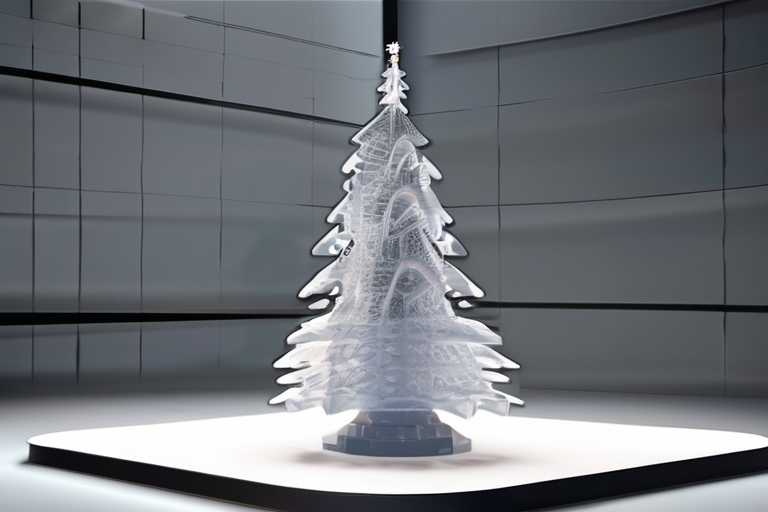
The concept of evaporative cooling has been studied extensively in various fields, including physics, biology, and engineering. However, its application in 3D printing has not been explored until now. The University of Amsterdam's team has demonstrated that evaporative cooling can be used to create complex structures, such as the miniature Christmas tree, without the need for specialized equipment.
The development of this technology has the potential to revolutionize the field of materials science and the creation of novel cooling systems. As Dr. [Name] noted, "This achievement opens up new possibilities for the development of sustainable and efficient cooling technologies, which can have a significant impact on various industries, including energy, transportation, and construction."
The team's research is currently in the preprint stage, and further studies are needed to fully understand the implications of this discovery. However, the potential for this technology to transform the field of materials science and beyond is vast. As the researchers continue to refine their technique, it will be exciting to see how this innovation evolves and is applied in various industries.
Physicists Craft Ice Christmas Tree with Revolutionary 3D Printing Technique
1
0
Multi-Source Journalism
This article synthesizes reporting from multiple credible news sources to provide comprehensive, balanced coverage.

























Share & Engage Share
Share this article