

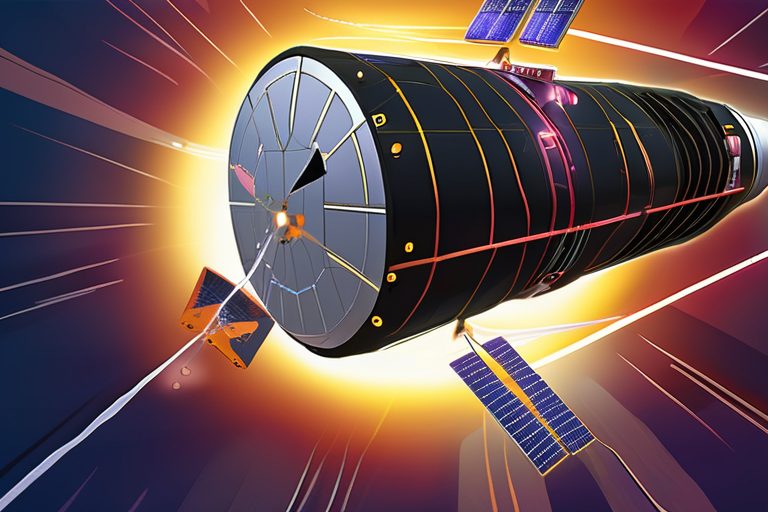
The Indian Space Research Organisation's Aditya-L1 spacecraft, launched in 2023, is set to observe the Sun during its peak activity phase in the coming year. Meanwhile, significant advancements in artificial intelligence (AI) research are expected to shape the scientific landscape in 2026. Researchers have already reported substantial progress in AI-powered science, with some predicting that AI may make its first consequential scientific breakthroughs next year.
According to Dr. Rachel Kim, a leading AI researcher at Stanford University, "The integration of large language models (LLMs) has been a game-changer in AI research. These models have enabled AI agents to tackle complex, multi-step processes with unprecedented efficiency. However, we're also seeing the emergence of new AI approaches that focus on designing smaller, specialized models that learn from limited data." Dr. Kim notes that these newer models, which process mathematical representations of information, have shown promising results in logic tests, outperforming their larger LLM counterparts.
The increasing reliance on AI in scientific research has sparked concerns about data integrity and potential errors. In an interview, Dr. John Taylor, a computer scientist at the University of California, Berkeley, emphasized the need for caution: "While AI has the potential to revolutionize science, we must acknowledge the risks associated with its use. We've already seen instances of AI agents deleting data or producing incorrect results. It's essential that we develop robust safeguards to mitigate these risks and ensure the reliability of AI-driven research."
The growing use of AI in science has also raised questions about accountability and oversight. As Dr. Kim points out, "As AI becomes more autonomous, it's essential that we establish clear guidelines for its use and development. We need to ensure that AI systems are transparent, explainable, and subject to human oversight whenever necessary." The scientific community is grappling with these challenges, and researchers are working to develop frameworks for responsible AI development.
In the context of AI research, the past year has seen significant advancements in the field. The development of AI-powered language models has enabled researchers to tackle complex scientific problems with unprecedented efficiency. However, the increasing reliance on AI has also highlighted the need for caution and oversight. As the scientific community continues to explore the potential of AI, it's essential that we prioritize transparency, accountability, and responsible development.
Looking ahead to 2026, researchers expect to see further developments in AI-powered science. The Indian Space Research Organisation's Aditya-L1 spacecraft will provide valuable insights into the Sun's behavior, while AI researchers will continue to push the boundaries of what's possible with AI. As Dr. Taylor notes, "The future of AI in science is exciting, but it's also uncertain. We must be prepared to adapt to the changing landscape and ensure that AI serves humanity's best interests."
Sun's Peak Activity and AI Breakthroughs: Top Science Events of 2026
1
0
Multi-Source Journalism
This article synthesizes reporting from multiple credible news sources to provide comprehensive, balanced coverage.



























Share & Engage Share
Share this article