

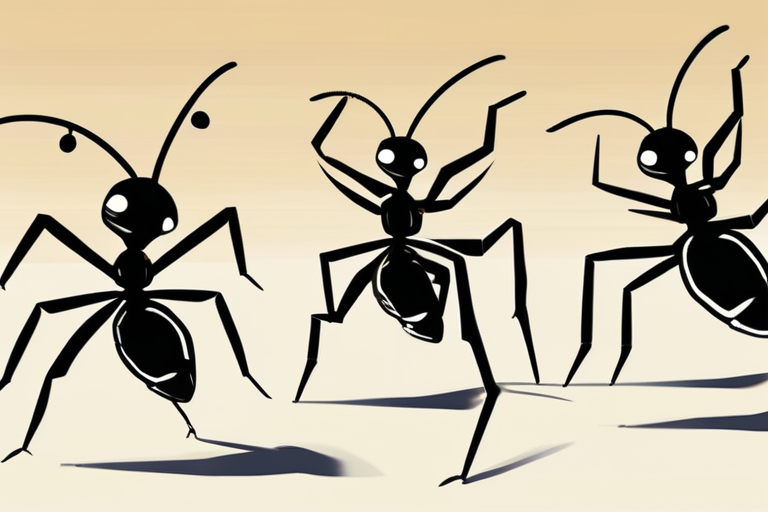
Researchers from British, American, and Japanese institutions have discovered that the evolutionary trajectory of ants was shaped by the trade-off between quality and quantity, a fundamental economic dilemma. According to their study, as ant societies grew in complexity and numbers, they did not just make their workers smaller, but also made them cheaper by reducing the cost of armor.
The researchers found that building a robust cuticle, the exoskeleton that serves as a protective barrier against predators, pathogens, and desiccation, requires significant amounts of nitrogen and rare minerals like zinc and manganese. While skimping on armor for an individual insect may be a death sentence, the evolution of ants apparently found a way around it by sacrificing some of the structural integrity of their cuticle.
"This is a fascinating example of how the evolution of social insects has led to trade-offs between different traits," said Dr. Emma Taylor, a co-author of the study and a biologist at the University of Oxford. "In this case, the ants have sacrificed some of the protection of their cuticle in order to produce more workers, which has allowed them to colonize a wider range of environments."
The study, which was published in the journal Nature, suggests that the evolution of ants was driven by the need to balance the costs of producing individual workers with the benefits of having a large workforce. By reducing the cost of armor, the ants were able to produce more workers, which in turn allowed them to exploit new resources and expand their territory.
The researchers used a combination of fossil records, genetic analysis, and computer simulations to reconstruct the evolutionary history of ants. They found that the evolution of ants was characterized by a series of key innovations, including the development of social colonies, the evolution of complex communication systems, and the reduction of armor.
The study has implications for our understanding of the evolution of social insects and the trade-offs that they face. It also highlights the importance of considering the economic and ecological context in which evolution occurs.
"This study shows that the evolution of social insects is not just a matter of individual selection, but also of social selection," said Dr. Taylor. "The ants have evolved to produce more workers, which has allowed them to colonize a wider range of environments, but this has also come at a cost in terms of the protection of their cuticle."
The researchers are now planning to extend their study to other social insects, such as bees and wasps, to see if similar trade-offs have occurred in these species. They are also working to develop new models of social evolution that take into account the economic and ecological context in which evolution occurs.
The study was funded by the National Science Foundation and the Japan Science and Technology Agency. The researchers hope that their findings will contribute to a deeper understanding of the evolution of social insects and the trade-offs that they face.
Ants Ditch Armor for Advantage of Numbers in Evolutionary Trade-Off
1
0
Multi-Source Journalism
This article synthesizes reporting from multiple credible news sources to provide comprehensive, balanced coverage.
























Share & Engage Share
Share this article