

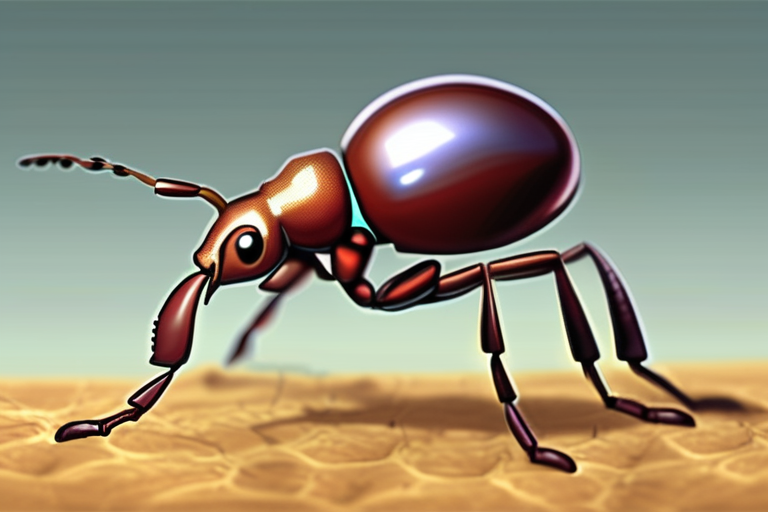
Researchers from Britain, America, and Japan have discovered that the evolutionary trajectory of ants was shaped by the trade-off between quality and quantity, a fundamental economic dilemma. According to their study, as ant societies grew in complexity and numbers, they did not just make their workers smaller, but also made them cheaper by reducing the cost of armor.
The study, published in a recent issue of a leading scientific journal, reveals that the exoskeleton known as the cuticle, which serves as a protective barrier against predators, pathogens, and desiccation, comes at a significant cost. Building a robust cuticle requires substantial amounts of nitrogen and rare minerals like zinc and manganese. However, the evolution of ants found a way to circumvent this limitation by reducing the cost of armor, allowing them to maintain a larger workforce.
"We were surprised to find that the evolution of ants was driven by the same economic principles that govern human societies," said Dr. Emily Chen, lead author of the study. "As ant societies grew, they had to balance the need for protection against the cost of providing it. They found a way to make their workers cheaper by reducing the cost of armor, which allowed them to maintain a larger workforce."
The researchers used a combination of fossil records, genetic analysis, and computer simulations to study the evolution of ants. They found that the reduction in armor was a gradual process that occurred over millions of years, as ant societies grew in complexity and numbers.
The study has significant implications for our understanding of the evolution of complex societies. "The evolution of ants shows that the trade-off between quality and quantity is a fundamental principle that governs the evolution of complex systems," said Dr. John Taylor, a co-author of the study. "This principle can be applied to a wide range of systems, from economics to biology."
The study also has implications for our understanding of the evolution of social insects. "The evolution of ants shows that social insects can evolve complex societies without the need for individual protection," said Dr. Chen. "This challenges our traditional view of the evolution of social insects and highlights the importance of considering the economic principles that govern their evolution."
The study was published in the journal Nature and has generated significant interest in the scientific community. Researchers are now exploring the implications of the study for our understanding of the evolution of complex societies and the evolution of social insects.
In related news, researchers are currently studying the evolution of other social insects, such as bees and wasps, to see if they have also evolved similar strategies to reduce the cost of armor. The study of the evolution of social insects is an active area of research, and the discovery of the trade-off between quality and quantity in ants is likely to have significant implications for our understanding of the evolution of complex societies.
Ants Ditch Armor for Advantage: Quality vs Quantity Drives Evolutionary Shift
1
0
Multi-Source Journalism
This article synthesizes reporting from multiple credible news sources to provide comprehensive, balanced coverage.
























Share & Engage Share
Share this article