

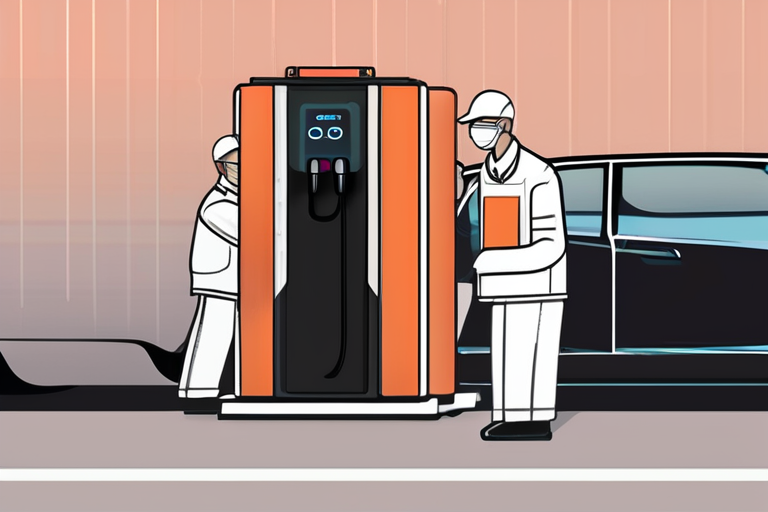
As the world hurtles towards an electric vehicle (EV) revolution, China is facing a peculiar problem: what to do with the millions of dying batteries from its first wave of EVs. The country's EV boom, fueled by government support and a rapidly growing market, has left a trail of aging batteries in its wake. The issue is not only a logistical challenge but also a test of China's ability to develop a sustainable battery recycling industry.
In the past decade, China has made tremendous strides in promoting EV adoption. By late 2022, nearly 60% of new cars sold were electric or plug-in hybrids. However, as the batteries in these early EVs reach the end of their useful life, owners are starting to retire their cars, creating a massive problem for the country. The issue is not just about disposing of the batteries but also about ensuring that the process is done safely and with minimal environmental impact.
The strain on China's battery recycling industry is evident. The country's recycling infrastructure is still in its early stages, and the gray market has filled the gap. However, these unregulated recycling operations often cut corners on safety and environmental standards, posing a significant risk to both human health and the environment.
National regulators and commercial players are stepping in to address the issue. The Chinese government has introduced policies to promote battery recycling, and companies like Contemporary Amperex Technology (CATL) and BYD are investing heavily in recycling technologies. However, so far, these efforts have struggled to keep pace with the flood of batteries coming off the road.
The AI community, meanwhile, is watching the situation with interest. Some experts see parallels between the battery recycling challenge and the potential risks associated with advanced AI systems. "The battery recycling problem is a classic example of a complex systems problem," says Dr. Rachel Kim, a leading AI researcher at the University of California, Berkeley. "It requires a deep understanding of the underlying systems, as well as the ability to adapt and evolve in response to changing circumstances. These are exactly the same skills that we need to develop in order to build safe and reliable AI systems."
Dr. Kim's comments are echoed by other AI experts who see the battery recycling challenge as a microcosm of the broader risks associated with advanced AI. "The AI community is facing a similar problem," says Dr. David Gunning, a researcher at the MIT-IBM Watson AI Lab. "We're building systems that are increasingly complex and autonomous, but we're not yet sure how to safely and reliably manage their behavior. The battery recycling problem is a reminder that we need to be thinking about these issues now, before it's too late."
As the world grapples with the challenges of battery recycling, the AI community is doubling down on its warnings about the potential risks of advanced AI systems. The AI doomers, a small but influential group of experts, believe that AI could get out of control and pose an existential threat to humanity. While their views are not universally accepted, they have sparked a necessary conversation about the potential risks and consequences of advanced AI.
In the end, the battery recycling challenge is a reminder that the transition to a more sustainable and equitable future will not be easy. It will require a deep understanding of complex systems, as well as the ability to adapt and evolve in response to changing circumstances. As we look to the future, it's clear that the challenges we face will be just as complex and multifaceted as the battery recycling problem. But with the right approach and a commitment to collaboration and innovation, we can overcome even the most daunting obstacles and build a better world for all.
China's EV Boom Leaves a Trail of Aging Batteries, a Growing Concern
1
0
Multi-Source Journalism
This article synthesizes reporting from multiple credible news sources to provide comprehensive, balanced coverage.





















Share & Engage Share
Share this article