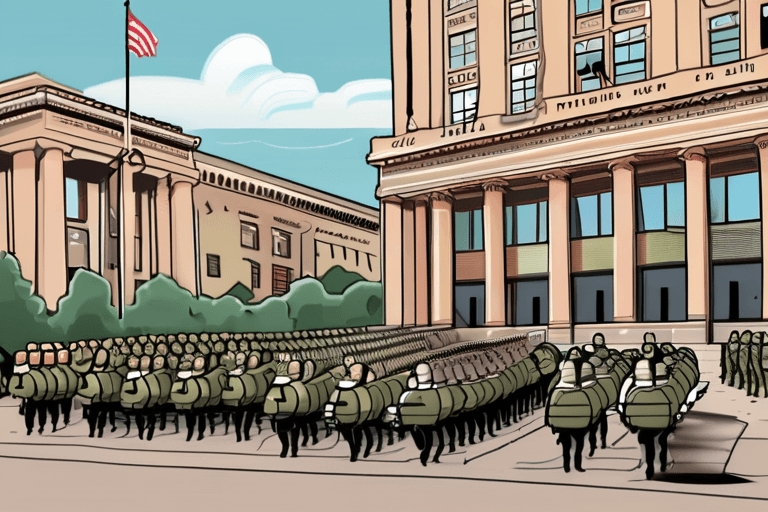
As the United States grapples with the complexities of modern-day protests and civil unrest, the Trump administration is taking a significant step towards deploying the National Guard for crowd control. The move has sparked intense debate, with many questioning the implications of such a drastic measure. But what lies behind this decision, and what does it say about the state of American society?
The creation of new National Guard quick reaction forces, designed specifically for crowd control, dates back to an August executive order. However, it's only recently that the plans for implementation have come to light, revealing a nationwide deployment of troops on short notice. This shift in focus from natural disasters to civil disturbances has raised eyebrows, both domestically and internationally.
In the United States, the National Guard has a long history of serving as a domestic force, often called upon to respond to natural disasters, border security, and other emergencies. However, the new quick reaction forces are a departure from this tradition, with a primary focus on quelling civil disturbances. This change in emphasis has been met with skepticism by many, who worry about the potential for military overreach and the erosion of civil liberties.
The global community is watching this development with great interest. In many countries, the use of military force for crowd control is seen as a last resort, and often a sign of a government's inability to manage its citizens. "The use of the military for crowd control is a worrying trend," says Dr. Maria Rodriguez, a human rights expert at the University of London. "It's a sign of a government's failure to engage with its citizens and address the root causes of unrest."
In the United States, the deployment of the National Guard for crowd control has been met with resistance from some quarters. "This is a slippery slope," says Senator Kirsten Gillibrand, a vocal critic of the Trump administration's policies. "Once we start using the military for domestic purposes, it's hard to draw the line. We risk creating a culture of fear and repression, rather than one of free speech and assembly."
The Trump administration, however, sees the new quick reaction forces as a necessary measure to maintain public order. "We need to be able to respond quickly and effectively to civil disturbances," says a senior administration official. "These new forces will allow us to do just that, while also protecting the rights of law-abiding citizens."
As the debate rages on, one thing is clear: the deployment of the National Guard for crowd control is a complex issue with far-reaching implications. It's a reminder that, in the United States, the line between military and civilian authority is often blurred, and that the use of force can have unintended consequences. As the world watches, the question on everyone's mind is: what's next?
In the end, the decision to deploy the National Guard for crowd control will have far-reaching consequences for American society and the world at large. It's a reminder that, in the words of Dr. Rodriguez, "the use of military force for crowd control is a sign of a government's failure to engage with its citizens and address the root causes of unrest." As the United States grapples with the complexities of modern-day protests and civil unrest, one thing is clear: the world is watching, and the stakes are high.




Discussion
Join 0 others in the conversation
Share Your Thoughts
Your voice matters in this discussion
Login to join the conversation
No comments yet
Be the first to share your thoughts!