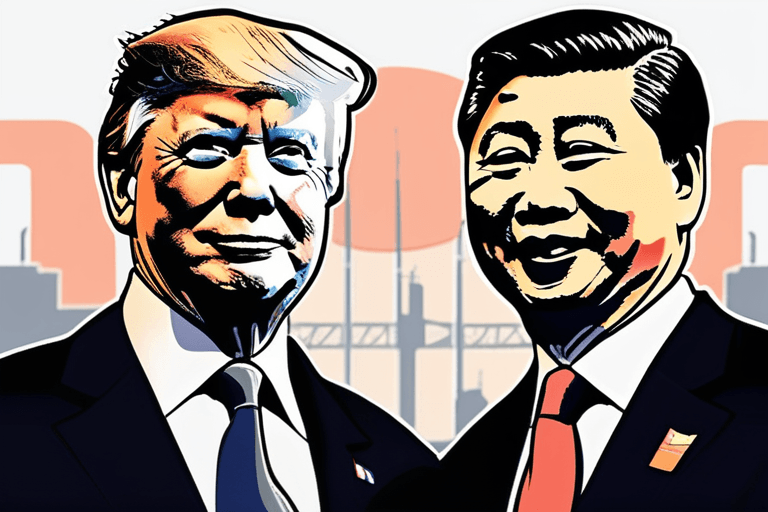
The United States and China have agreed to ease their trade war, with both sides making concessions to put some of the most painful measures on hold for a year. According to sources, the decision was reached during a meeting between Donald Trump and Xi Jinping, their first since 2019. The move is seen as a significant step towards resolving the long-standing trade tensions between the world's two largest economies.
Andy Mok, a senior research fellow at the Center for China and Globalization think tank in Beijing, described the agreement as a "temporary truce" that allows both sides to regroup and reassess their strategies. "This is a tactical decision, not a strategic one," Mok said. "Both sides are giving each other some breathing room, but the underlying issues remain unresolved."
Neil Thomas, a fellow on Chinese politics at the Asia Society Policy Institute's Center for China Analysis in Washington, DC, noted that the agreement is a result of China's willingness to make concessions, including reducing tariffs on some US goods. "China has shown a willingness to compromise, but the US has also made some concessions, such as delaying some of the tariffs," Thomas said.
William Lee, chief economist at the Milken Institute in Los Angeles, emphasized that the agreement is a short-term solution that does not address the fundamental issues driving the trade tensions. "The underlying issues, such as intellectual property theft and market access, remain unresolved," Lee said. "This agreement is a Band-Aid solution that will not last unless both sides make deeper concessions."
The trade war between the US and China began in 2018, with the US imposing tariffs on Chinese goods worth over $360 billion. China retaliated with its own tariffs on US goods, leading to a significant decline in trade between the two countries. The tensions escalated in 2019, with the US imposing additional tariffs on Chinese goods and China imposing its own tariffs on US goods.
The agreement reached between Trump and Xi Jinping is seen as a significant step towards resolving the trade tensions, but experts caution that the underlying issues remain unresolved. The agreement puts some of the most painful measures on hold for a year, but it does not address the fundamental issues driving the trade tensions.
As the agreement takes effect, both sides will be closely watching each other's actions to see if the temporary truce holds. The next developments will be crucial in determining the long-term outlook for US-China trade relations.





Discussion
Join 0 others in the conversation
Share Your Thoughts
Your voice matters in this discussion
Login to join the conversation
No comments yet
Be the first to share your thoughts!