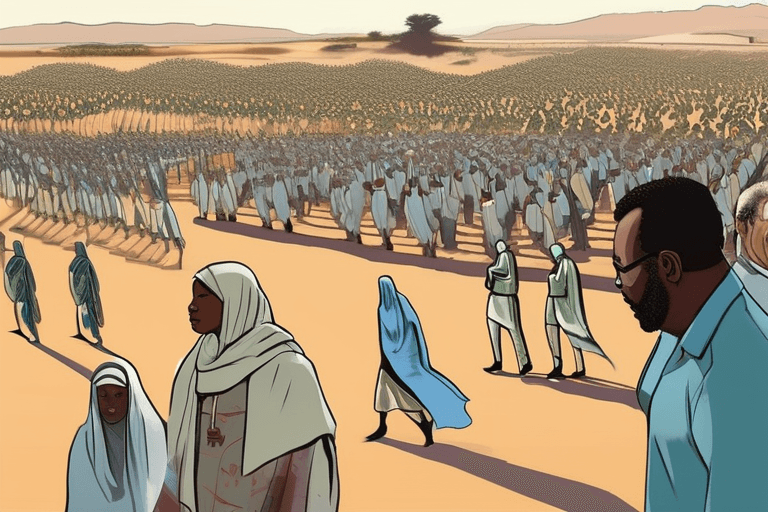
The international community is widely condemning Israel's formal recognition of Somaliland as an independent state. The Arab League, the Gulf Cooperation Council (GCC), the African Union (AU), and the Organization of Islamic Cooperation (OIC) have joined a growing chorus of countries and foreign ministers in expressing their disapproval of the move.
Somaliland, located in the Horn of Africa, declared its independence from Somalia in 1991 following the collapse of the Somali central government. Despite maintaining a relatively stable government and its own currency, passport, and institutions, Somaliland has struggled to gain international recognition. President Abdirahman Mohamed Abdullahi has made achieving this recognition a key priority since assuming office last year.
Israel's announcement on Friday that it considers Somaliland an independent and sovereign state has been met with strong opposition, particularly from Somalia, which views Somaliland as an integral part of its territory. Somalia's government has demanded that Israel rescind its recognition.
The Arab League, representing 22 Arab states, issued a statement reiterating its commitment to Somalia's sovereignty and territorial integrity. The GCC, a political and economic alliance of six Middle Eastern countries, echoed this sentiment. The African Union, comprised of 55 member states, has historically supported the territorial integrity of its member states, making Israel's recognition of Somaliland a challenge to its established principles. The OIC, representing 57 Muslim-majority countries, also voiced its opposition.
The move by Israel is seen by some analysts as an attempt to gain a strategic foothold in the Horn of Africa and to potentially counter Iranian influence in the region. Others suggest it is a calculated decision to establish relations with a stable, self-governing entity in a volatile region.
The recognition has sparked debate within Israel as well, with some questioning the potential ramifications for its relations with other African nations and the broader international community. The long-term implications of Israel's decision remain to be seen, but it has undoubtedly introduced a new layer of complexity to the already intricate geopolitical landscape of the Horn of Africa.


















Discussion
Join the conversation
Be the first to comment