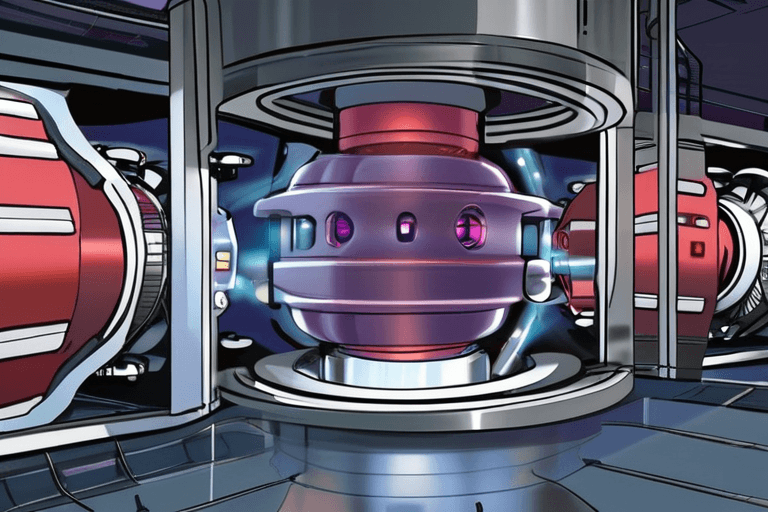
According to the research team, the theoretical method involves harnessing the intense neutron flux within fusion reactors to trigger the creation of axions. These elusive particles are prime candidates for dark matter, the mysterious substance that makes up a significant portion of the universe's mass but does not interact with light. The study suggests that the unique environment inside a fusion reactor could provide the necessary conditions to produce and potentially detect these particles.
"This is a game-changer," said Dr. Arlo Preuss, lead author of the study and a physicist at the University of Cincinnati. "For years, physicists have been searching for axions with little success. Fusion reactors, which are on the cusp of becoming a reality, could offer a completely new way to find them."
The concept of axions gained prominence in the 1970s as a theoretical solution to a problem in particle physics known as the strong CP problem. Despite numerous experiments, axions have remained elusive, leading some scientists to question their existence. The "Big Bang Theory" even poked fun at the difficulty of finding these particles, with characters Sheldon and Leonard comically failing in their attempts to solve the axion puzzle.
The potential discovery of axions would not only validate a long-standing theoretical prediction but also provide crucial insights into the nature of dark matter. This could revolutionize our understanding of the universe and its fundamental constituents. Moreover, the ability to produce axions in fusion reactors could open up new avenues for research and technological applications.
Industry experts suggest that this research could inject new excitement into the field of fusion energy, which has been gaining momentum as a potential source of clean and sustainable power. The added possibility of producing dark matter particles could attract further investment and accelerate the development of fusion technology.
"This is an incredibly exciting development," said Dr. Emily Carter, a leading expert in fusion energy at MIT, who was not involved in the study. "It highlights the potential of fusion reactors to not only solve our energy needs but also to address some of the biggest mysteries in physics."
The research team is currently working on developing experimental methods to detect axions produced in fusion reactors. They hope to collaborate with existing and future fusion facilities to test their theoretical predictions. The next step involves designing specific detectors that can identify the faint signals produced by axions amidst the intense radiation environment of a fusion reactor. The study was published in the journal Physical Review Letters on December 28, 2025.






















Discussion
Join the conversation
Be the first to comment