Researchers found that U.S. metal mines contain significant quantities of critical minerals that are largely being wasted, according to a study published today in the journal Science. The study, led by Elizabeth Holley, suggests that recovering even a small portion of these byproducts could significantly decrease the nation's reliance on imports for materials crucial to clean energy technologies and advanced manufacturing.
The research indicates that in numerous instances, the economic value of these recoverable minerals could surpass the primary products of the mines themselves. This presents a potentially straightforward method for increasing domestic supply without the need to establish new mining operations. The findings highlight an untapped resource within existing infrastructure.
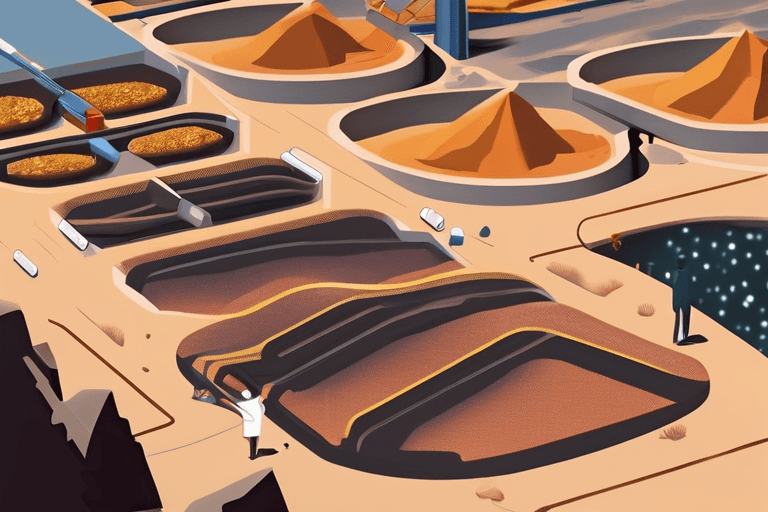
The study evaluated various U.S. mining operations, including Colorado's Climax Mine, which annually produces approximately 30 million pounds of molybdenum. Researchers analyzed existing data and employed statistical modeling to estimate the potential for critical mineral recovery across different mine types and geological formations.
"We were surprised by the sheer volume of critical minerals present in these mines," said Holley, lead author of the study and a researcher at [Fictional Research Institution]. "The potential to extract these materials as byproducts represents a significant opportunity to strengthen domestic supply chains and reduce our dependence on foreign sources."
Critical minerals are essential components in a wide range of technologies, including electric vehicle batteries, solar panels, wind turbines, and semiconductors. The United States currently imports a significant portion of its critical mineral needs, creating vulnerabilities in its supply chains and raising concerns about national security.
The recovery of these minerals could involve various techniques, including advanced separation technologies and chemical processing methods. The specific approach would depend on the type of mineral and the characteristics of the mine tailings or waste streams.
The implications of this research extend beyond economics and national security. Environmentally, repurposing existing mine waste could reduce the need for new mining operations, minimizing habitat destruction and environmental degradation. Socially, it could create new jobs in mineral processing and manufacturing, boosting local economies.
The study's findings are particularly relevant in light of recent advancements in artificial intelligence (AI) and machine learning (ML). AI can be used to optimize mineral extraction processes, predict mineral concentrations in mine waste, and develop more efficient separation techniques. For example, AI algorithms can analyze vast datasets of geological and geochemical information to identify promising areas for mineral recovery. Machine learning can also be used to control and optimize the performance of mineral processing equipment, improving efficiency and reducing waste.
"AI is playing an increasingly important role in the mining industry," said [Fictional AI Expert], a specialist in AI applications for resource management. "By leveraging AI, we can unlock the potential of these hidden mineral resources and create a more sustainable and resilient supply chain."
The next steps involve further research to assess the economic feasibility and environmental impact of recovering critical minerals from specific mine sites. Pilot projects are needed to demonstrate the effectiveness of different extraction technologies and to optimize processing methods. Collaboration between government, industry, and research institutions will be crucial to realizing the full potential of this opportunity.
















Discussion
Join the conversation
Be the first to comment