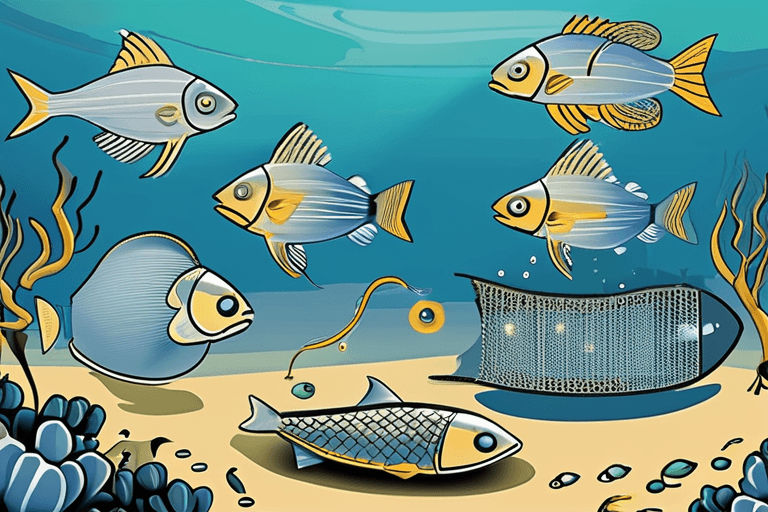
Scientists at the Woods Hole Oceanographic Institution (WHOI) discovered that mid-sized fish, such as the bigscale pomfret, play a crucial role in connecting the deep-sea and surface food webs, explaining why large predators like sharks spend significant time in the ocean's twilight zone. Researchers tracked these fish, which inhabit the mesopelagic zone during the day and ascend to feed at night, using satellite tags for the first time, revealing their movements and their importance in the marine ecosystem. The study, published this week, highlights how these fish act as a "missing link" in the ocean's food chain.
The mesopelagic zone, also known as the twilight zone, spans depths of 200 to 1,000 meters (650 to 3,300 feet) and is a dimly lit region of the ocean. Danny Mears, a scientist at WHOI, explained that the bigscale pomfret and similar mid-sized fish undertake daily vertical migrations, moving between the deep and surface waters. This behavior transfers energy and nutrients from the surface, where sunlight fuels photosynthesis, to the deeper ocean, supporting a complex food web.
The research team employed satellite-based tracking tags to monitor the movements of bigscale pomfret. This allowed them to gather data on the fish's depth, location, and behavior over extended periods. The data revealed that the fish's movements are influenced by water clarity, with the fish diving deeper in clearer waters and remaining shallower in murkier conditions. This adaptability suggests that changes in ocean conditions, such as increased turbidity due to climate change, could significantly impact their behavior and, consequently, the entire ocean food chain.
"These mid-sized fish are like the unsung heroes of the ocean," said Mears. "They're not as charismatic as sharks or whales, but they play a vital role in keeping the ecosystem functioning." The study's findings have implications for understanding the distribution and behavior of larger predators, as well as the overall health of the ocean.
The use of satellite tags represents a significant advancement in the study of deep-sea fish. Traditional methods, such as net trawls, can be disruptive and provide only a snapshot of the fish's behavior. Satellite tags, on the other hand, allow researchers to track the fish over time without disturbing their natural environment. The tags collect data on various parameters, including depth, temperature, and light levels, providing a comprehensive picture of the fish's habitat and behavior.
Future research will focus on expanding the study to include other species of mid-sized fish and investigating the impact of climate change on their behavior and distribution. Scientists also plan to use artificial intelligence (AI) to analyze the vast amounts of data collected by the satellite tags, potentially uncovering new insights into the complex interactions within the ocean ecosystem. The application of AI in this context involves using machine learning algorithms to identify patterns and relationships in the data that might be missed by human analysis. This could lead to a better understanding of how the ocean's food web is structured and how it is changing over time.

















Discussion
Join the conversation
Be the first to comment