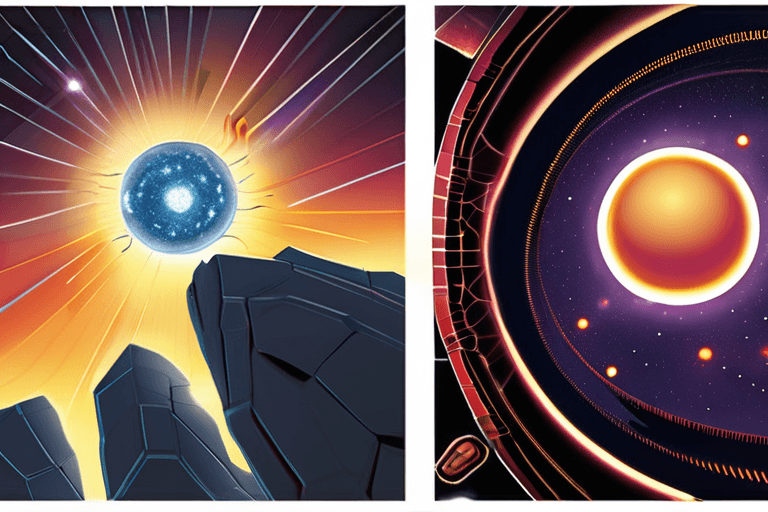
The James Webb Space Telescope (JWST) has spotted the most distant supernova ever observed. The stellar explosion, dubbed SN in GRB 250314A, occurred when the universe was less than a billion years old. Scientists confirmed the event after a gamma-ray burst signaled its location.
Astronomers detected the supernova on December 28, 2025. JWST pinpointed the blast and isolated it from its host galaxy. The explosion remarkably resembles supernovae linked to gamma-ray bursts in the modern universe.
This discovery marks a major milestone in studying the early universe. Scientists can now analyze the death of a massive star from cosmic dawn. The findings provide crucial data for understanding stellar evolution in the early universe.
Supernovae are powerful explosions marking the end of a star's life. They distribute heavy elements into space, seeding new generations of stars and planets. Studying distant supernovae helps us understand the universe's chemical enrichment over time.
Researchers will continue to analyze data from SN in GRB 250314A. Future observations will refine our understanding of early star formation. The team hopes to uncover more distant supernovae with JWST.

















Discussion
Join the conversation
Be the first to comment