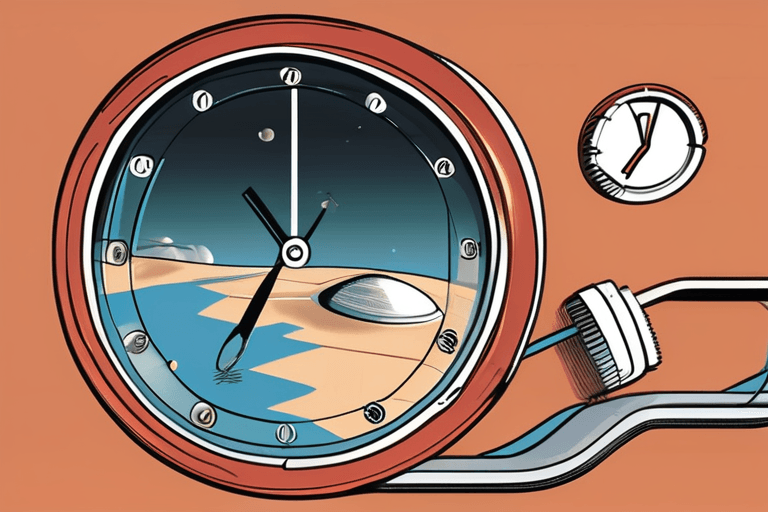
Time runs faster on Mars than on Earth, according to new findings published by scientists at the National Institute of Standards and Technology (NIST) on December 30, 2025. The research confirms Albert Einstein's theory of relativity, demonstrating that time's passage is not uniform throughout the universe and is affected by gravity.
The NIST team precisely quantified the time difference, revealing that clocks on Mars tick slightly faster than those on Earth. These microsecond variations fluctuate throughout the Martian year. "This is a small time gap with big consequences for space exploration," stated Dr. Emily Carter, lead researcher at NIST.
The difference in time arises because Mars has less gravity than Earth. According to Einstein's theory, the weaker the gravitational field, the faster time passes. While the difference may seem insignificant, these microsecond shifts could have a substantial impact on future Mars missions.
Precise timekeeping is crucial for navigation, communication, and data synchronization. As humans explore Mars and potentially establish a permanent presence, accurate time synchronization between Earth and Mars will be essential. The NIST findings suggest that these time discrepancies must be accounted for in future mission planning.
"If we want to build a solar-system-wide internet, or even just ensure reliable communication with rovers and future Martian habitats, we need to understand and compensate for these relativistic effects," explained Dr. Carter.
Currently, Earth relies on a sophisticated global system of atomic clocks, GPS satellites, and high-speed communication networks to maintain precise time. Extending this level of accuracy to Mars presents a significant challenge.
The NIST research team used advanced atomic clocks and complex mathematical models to measure the time dilation effect between the two planets. Their work provides a foundation for developing new technologies and protocols for timekeeping in deep space.
The implications of this research extend beyond Mars. As humanity ventures further into the solar system, understanding and accounting for relativistic time differences will become increasingly important. The NIST findings represent a crucial step towards enabling accurate navigation and communication throughout the cosmos.




















Discussion
Join the conversation
Be the first to comment