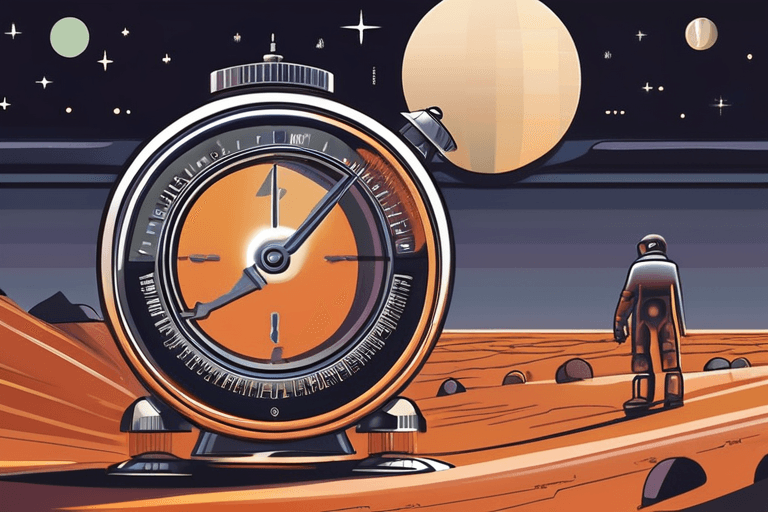
Time runs faster on Mars than on Earth, according to new findings published by the National Institute of Standards and Technology (NIST) on December 30, 2025. The research confirms Albert Einstein's theory of relativity, demonstrating that time's passage is relative and influenced by gravity. NIST scientists precisely quantified the difference, revealing that clocks on Mars tick slightly faster and experience fluctuations throughout the Martian year.
The discrepancy, though minuscule, has significant implications for future Mars missions, including navigation, communication, and the potential development of a solar-system-wide internet. "This is not just an academic exercise," said Dr. Emily Carter, lead researcher at NIST. "These microsecond differences accumulate and could lead to substantial errors if not accounted for in long-duration missions."
Einstein's theory of general relativity posits that time is relative and affected by gravity and velocity. Because Mars has less mass than Earth, its gravitational pull is weaker. This weaker gravity means that time passes slightly faster on Mars compared to Earth. The NIST team used advanced atomic clocks and sophisticated mathematical models to precisely measure this difference. They found that a clock on Mars would gain approximately a few microseconds per Earth day relative to a clock on Earth. The exact amount varies depending on Mars' position in its orbit, leading to fluctuations throughout the Martian year.
The implications of this time dilation are far-reaching. Precise timekeeping is crucial for accurate navigation, especially for spacecraft traveling vast distances. Without accounting for the relativistic effects, errors in positioning could accumulate, potentially leading to mission failures. Furthermore, reliable communication between Earth and Mars relies on synchronized timing. A solar-system-wide internet, envisioned by some space exploration advocates, would require extremely precise time synchronization across different planetary bodies.
"Imagine trying to download a file from Earth to Mars, or vice versa, without accounting for these time differences," explained Dr. Carter. "The data packets would arrive out of sync, rendering the information useless."
Currently, NASA and other space agencies use complex algorithms to compensate for relativistic effects in their missions. However, the new NIST findings provide a more precise understanding of the time dilation on Mars, allowing for even more accurate corrections. This increased accuracy will be essential for future, more ambitious missions, such as establishing a permanent human presence on Mars.
The NIST team is now working on developing even more precise atomic clocks that could be deployed on Mars to provide real-time time synchronization. These clocks would serve as the foundation for a Martian time standard, similar to Coordinated Universal Time (UTC) on Earth. The development of such a standard is considered a crucial step towards enabling seamless communication and navigation throughout the solar system.





















Discussion
Join the conversation
Be the first to comment