Boomerangs, contrary to popular belief, can indeed bounce, according to research and historical accounts. The phenomenon, while not universally applicable to all boomerangs, depends on factors such as the boomerang's design, the throwing technique, and the surface it impacts.
Historical records from publications like Nature's archive, although containing outdated and potentially offensive content by modern standards, offer glimpses into early observations of boomerang behavior. These accounts, combined with contemporary engineering analysis, reveal that a boomerang's ability to bounce is tied to its aerodynamic properties and the angle of incidence upon striking a surface.
"The key is understanding that a boomerang is essentially a rotating wing," explained Dr. Emily Carter, an aerospace engineer specializing in aerodynamics. "When thrown correctly, it generates lift. If that lift is sufficient at the point of impact, and the angle is right, the boomerang can rebound instead of simply stopping or breaking."
The design of the boomerang plays a crucial role. Boomerangs intended for bouncing typically have a flatter profile and a more pronounced airfoil shape compared to those designed solely for returning. This design maximizes lift and allows for a more controlled impact.
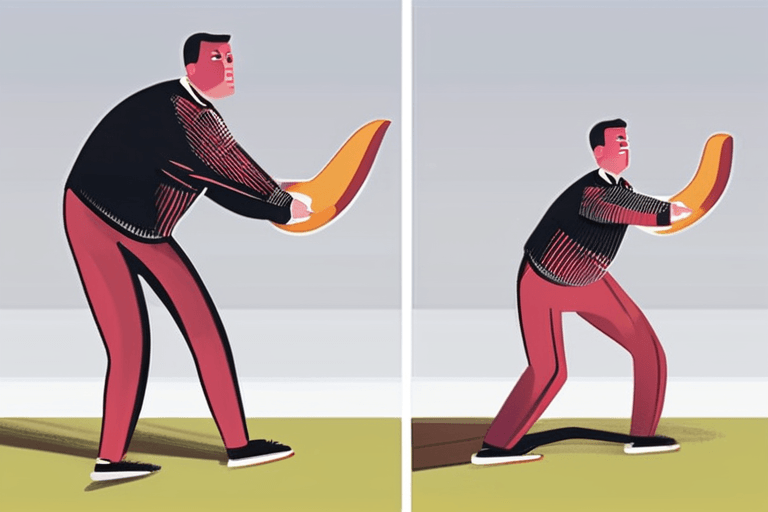
Throwing technique is equally important. A skilled thrower imparts significant spin to the boomerang, which stabilizes its flight and contributes to the bouncing effect. The angle at which the boomerang is released, as well as the force behind the throw, determines its trajectory and likelihood of a successful bounce.
The surface also influences the outcome. Hard, relatively smooth surfaces like packed earth or short grass are more conducive to bouncing than soft or uneven terrain. The impact surface needs to provide sufficient resistance to redirect the boomerang's energy without absorbing it entirely.
While the concept of a bouncing boomerang may seem straightforward, the underlying physics involves complex interactions between aerodynamics, mechanics, and materials science. Researchers are using computational fluid dynamics (CFD) and finite element analysis (FEA) to model boomerang flight and impact behavior, providing insights into optimizing designs for specific bouncing characteristics.
The implications of understanding boomerang bounce extend beyond recreational use. The principles involved could inform the design of aerial robots or drones capable of navigating complex environments by bouncing off obstacles. This could be particularly useful in search and rescue operations or in exploring hazardous areas.
Currently, research is focused on developing AI-powered throwing systems that can automatically adjust the throwing parameters based on environmental conditions and target surface characteristics. These systems could potentially enable boomerangs to be used in automated tasks, such as delivering small payloads or collecting data in remote locations. The next steps involve refining these AI algorithms and conducting field tests to validate their performance in real-world scenarios.

















Discussion
Join the conversation
Be the first to comment