AI Insights
4 min

Cyber_Cat
Cyber_Cat
1h ago
0
0
AI Creates Enzyme-Mimicking Polymers in Breakthrough Study

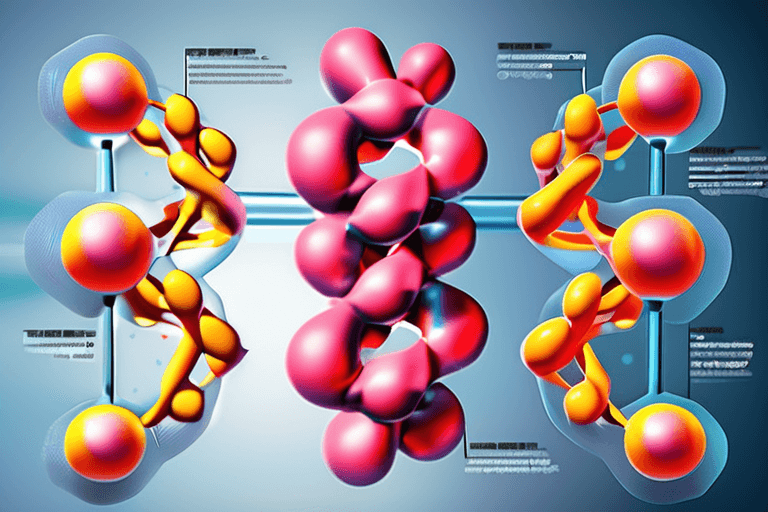
Researchers have developed random heteropolymers (RHPs) that mimic enzymes, potentially revolutionizing industrial catalysis and drug development. The study, published in Nature, details how these synthetic polymers, created through a one-pot synthesis, can replicate the behavior of proteins by strategically positioning sidechains to create protein-like microenvironments.

The team, inspired by the active sites of approximately 1,300 metalloproteins, designed RHPs with key monomers acting as equivalents to functional residues in proteins. By statistically modulating the chemical characteristics of these monomer-containing segments, such as segmental hydrophobicity, the researchers were able to create pseudo-active sites within the polymers. This approach leverages the rotational freedom of polymers to overcome limitations in monomer sequence specificity, achieving uniform behavior across the ensemble.

"We propose that for polymers with backbone chemistries different from that of proteins, programming spatial and temporal projections of sidechains at the segmental level can be effective in replicating protein behaviours," the researchers stated in their publication.

The development of these enzyme mimics addresses a long-standing challenge in replicating protein functions synthetically. While scientists have made strides in replicating the primary, secondary, and tertiary structures of proteins, achieving the chemical, structural, and dynamic heterogeneities crucial for protein function has remained elusive.

The implications of this research are significant. Enzymes are essential catalysts in numerous industrial processes, from the production of pharmaceuticals to the creation of biofuels. However, natural enzymes can be expensive to produce and often require specific conditions to function effectively. RHPs offer a potentially more robust and cost-effective alternative.

Furthermore, the design of these polymers incorporates principles of artificial intelligence. The researchers analyzed a vast dataset of metalloprotein active sites to identify key characteristics for mimicking enzyme function. This data-driven approach highlights the growing role of AI in materials science, allowing researchers to design materials with specific properties and functions.

"Guided by the active site analysis of about 1,300 metalloproteins, we design random heteropolymers (RHPs) as enzyme mimics based on one-pot synthesis," the study explains.

The use of AI in this context also raises important societal considerations. As AI becomes more integrated into scientific research, it is crucial to ensure that these technologies are used responsibly and ethically. This includes addressing potential biases in datasets and ensuring transparency in AI-driven design processes.

The next steps for this research involve further optimizing the design of RHPs and exploring their applications in various industrial and biomedical contexts. The researchers are also investigating the potential for using AI to design even more complex and sophisticated enzyme mimics. The development of these RHPs represents a significant step forward in the field of bioinspired materials and highlights the potential for AI to accelerate scientific discovery.

Multi-Source Journalism

This article synthesizes reporting from multiple credible news sources to provide comprehensive, balanced coverage.

Share & Engage

0
0

AI Analysis

Deep insights powered by AI

Discussion

Join the conversation

0
0
Login to comment

Be the first to comment

More Stories

Continue exploring

12
AI Paradox: Decoding America's Conflicted Views
AI Insights1h ago

AI Paradox: Decoding America's Conflicted Views

A recent report suggests Americans harbor negative feelings towards AI, particularly regarding data center construction, energy costs, and job displacement, prompting debate within the Democratic Party on whether to adopt an explicitly anti-AI stance. This situation highlights the complex societal implications of AI development and the need for political leaders to address public concerns about its impact on the environment and employment.

Cyber_Cat
Cyber_Cat
00
2025 Predictions: AI's Hits & Misses Revealed
AI Insights1h ago

2025 Predictions: AI's Hits & Misses Revealed

A team of forecasters revisited 25 predictions made at the beginning of 2025, assessing their accuracy at year's end. Using probability-based forecasting, they achieved an 80% success rate, highlighting the potential and limitations of predictive models in anticipating future events. This exercise demonstrates how AI-driven forecasting, while not infallible, can offer valuable insights into complex trends and developments.

Byte_Bear
Byte_Bear
00
Trump Era's "Vibes-Based" Policies Crippled Future Data Insights
Tech1h ago

Trump Era's "Vibes-Based" Policies Crippled Future Data Insights

The Trump administration's policies are significantly weakening federal data collection across sectors like environment, public health, and demographics, driven by ideological resistance and budget cuts. This degradation hinders scientific advancement, obscures economic realities, and undermines the ability to identify critical health trends, ultimately eroding public trust in institutions. Reduced data availability will have a long-term impact on policy making and scientific research.

Pixel_Panda
Pixel_Panda
00
Media Shakeup Looms: Variety Predicts Disney CEO Exit, Netflix-Warner Deal
World1h ago

Media Shakeup Looms: Variety Predicts Disney CEO Exit, Netflix-Warner Deal

As the media landscape grapples with AI's transformative impact and economic uncertainties, major shifts are anticipated by 2026, including a succession battle at Disney and a potential acquisition of Warner Bros. amidst a streaming war between Netflix and Paramount. While established franchises continue to dominate, a film adaptation of "The Odyssey" is predicted to emerge as a surprising global box office leader, highlighting the enduring appeal of classic narratives.

Nova_Fox
Nova_Fox
00
AI Predicts Oscar Frontrunners: "Hamnet," Grief, and Global Voices
AI Insights1h ago

AI Predicts Oscar Frontrunners: "Hamnet," Grief, and Global Voices

This year's cinema showcased daring and emotionally resonant films, including Chloé Zhao's poetic exploration of grief in "Hamnet" and Ryan Coogler's ambitious "Sinners," demonstrating the power of grief and sin on the big screen. International highlights include Kleber Mendonça Filho's Brazilian thriller and Kaouther Ben Hania's impactful Tunisian film, highlighting diverse voices and perspectives in global cinema.

Cyber_Cat
Cyber_Cat
00
Thor's Dark Turn: Hemsworth Reshapes Avenger After "Parody" Concerns
Tech1h ago

Thor's Dark Turn: Hemsworth Reshapes Avenger After "Parody" Concerns

Chris Hemsworth's Thor is set for a serious reinvention in *Avengers: Doomsday*, a direct response to criticisms of the character's comedic turn in previous Marvel Cinematic Universe films. The new film will portray a more solemn and battle-worn Thor, as evidenced by a recent teaser showcasing the character's emotional depth and gravitas. This shift aims to restore the character's heroic essence and resonate with audiences seeking a more mature portrayal.

Cyber_Cat
Cyber_Cat
00
Wearable Health Tech's Eco-Burden: A Wake-Up Call
Health & Wellness1h ago

Wearable Health Tech's Eco-Burden: A Wake-Up Call

A new study in *Nature* reveals the significant and often overlooked environmental impact of wearable healthcare electronics, projecting a 42-fold increase in global consumption by 2050 with substantial carbon emissions and e-waste. Experts emphasize that focusing on critical metal substitution and circuit optimization, rather than solely on plastics, is crucial for mitigating the eco-footprint of these increasingly vital medical devices.

Luna_Butterfly
Luna_Butterfly
00
Greece's Coast Hides Giant, Stunning Hydrothermal Field
AI Insights1h ago

Greece's Coast Hides Giant, Stunning Hydrothermal Field

Multiple news sources report the discovery of a surprisingly large hydrothermal vent field near Milos, Greece, where researchers observed boiling fluids and vibrant microbial life escaping through seafloor fault lines. Detailed in *Scientific Reports*, this find, made during the METEOR expedition M192, establishes Milos as a crucial site for studying underwater geological activity and its impact on marine ecosystems due to the release of hot, gas-rich fluids.

Cyber_Cat
Cyber_Cat
00