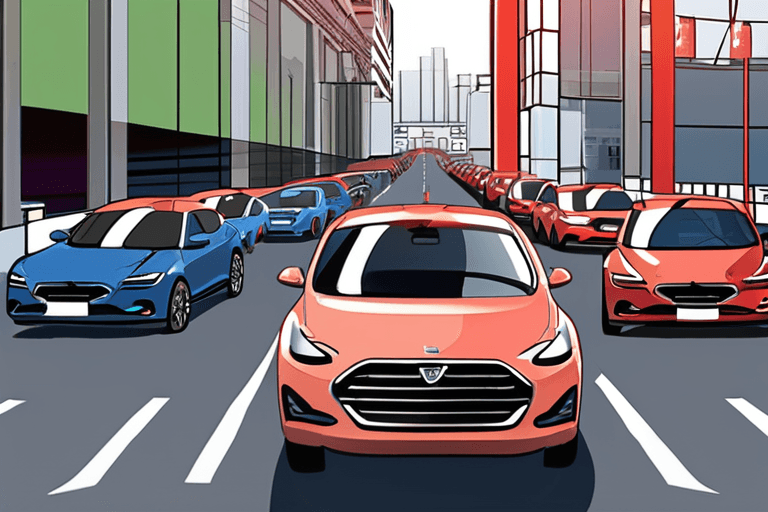
Chinese automotive brands are projected to capture one in every ten new car sales in the United Kingdom during 2025, marking a significant increase in market share, according to new analysis. Carmakers such as MG, BYD, and Chery are expected to surpass 200,000 units sold in the UK next year, doubling their 2024 total, said Matthias Schmidt, an analyst who tracks electric vehicle sales across Europe.
This surge in sales indicates that Chinese brands are likely to account for 10% of the UK's new car market in 2025. Schmidt noted that Spain and Norway are also seeing similar trends, with Chinese brands accounting for a tenth of their new car sales. The average across western Europe is currently at 6%.
China has established a leading position in the global electric vehicle (EV) industry through substantial government subsidies, control over the lithium-ion battery supply chain, and lower labor costs. This has enabled Chinese manufacturers to produce and export EVs at competitive prices.
The increasing presence of Chinese EVs in the UK and Europe reflects a broader shift in the automotive industry, driven by the transition to electric mobility and the growing competitiveness of Chinese manufacturers. The rise of AI in automotive design and manufacturing has further accelerated this trend, allowing for more efficient production processes and innovative vehicle features.
The automotive industry is undergoing a transformation fueled by artificial intelligence (AI). AI algorithms are used in the design and development of new vehicles, optimizing performance, safety, and energy efficiency. AI-powered manufacturing processes enhance precision and reduce production costs. AI is also integral to autonomous driving systems, which are becoming increasingly sophisticated.
The implications of this trend are far-reaching. The increased adoption of EVs contributes to reducing carbon emissions and improving air quality. However, it also raises questions about the future of traditional automotive manufacturing in Europe and the potential impact on employment. The dominance of Chinese companies in the EV supply chain also raises concerns about strategic dependencies.
The latest developments in AI include advancements in machine learning, computer vision, and natural language processing. These technologies are being applied to improve the performance of autonomous driving systems, enhance the user experience in EVs, and optimize the charging infrastructure for electric vehicles.
The projected increase in Chinese car sales in the UK highlights the growing importance of China in the global automotive industry and the transformative impact of electric vehicles and artificial intelligence on the sector.



















Discussion
Join the conversation
Be the first to comment