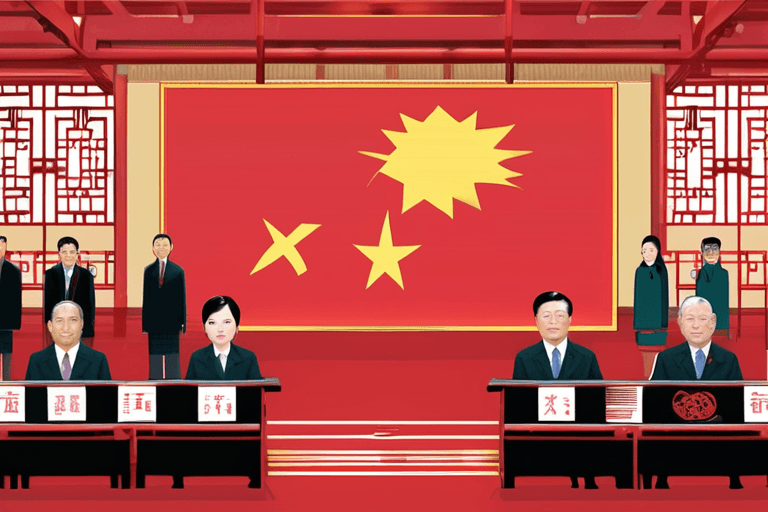
Chinese President Xi Jinping stated in his annual New Year's Eve speech in Beijing that the reunification of China and Taiwan is inevitable. The statement came a day after the conclusion of extensive Chinese military exercises conducted around Taiwan.
Xi Jinping asserted that "The reunification of our motherland, a trend of the times, is unstoppable." China considers Taiwan, a self-governing island, to be a part of its territory and has long maintained its intention to annex it, potentially through the use of force.
These remarks follow two days of live-fire military drills conducted by China's People's Liberation Army (PLA) around Taiwan. The exercises simulated a blockade of key Taiwanese ports and involved naval and air force assets.
China's stance on Taiwan is rooted in its "One China" principle, which asserts that there is only one sovereign state under the name "China," and that Taiwan is an inalienable part of that China. Taiwan, officially known as the Republic of China (ROC), has its own democratically elected government and maintains that it is a sovereign entity.
The United States maintains a policy of "strategic ambiguity" regarding Taiwan, neither confirming nor denying whether it would intervene militarily in the event of a Chinese attack. However, the U.S. has increased its military presence in the region and has expressed strong opposition to any unilateral attempts by China to alter the status quo.
U.S. intelligence agencies have expressed growing concern regarding the increasing capabilities of China's armed forces to potentially launch an attack on Taiwan, should Xi Jinping decide that the timing is appropriate. The military drills conducted this week served as a demonstration of China's capabilities and a signal of its resolve on the Taiwan issue.
The situation remains tense, with the potential for miscalculation or escalation. The international community is closely monitoring developments, as any conflict in the Taiwan Strait would have significant global implications. Future developments will likely involve continued diplomatic efforts to manage tensions, ongoing military activities in the region, and further assessments of China's intentions and capabilities.















Discussion
Join the conversation
Be the first to comment