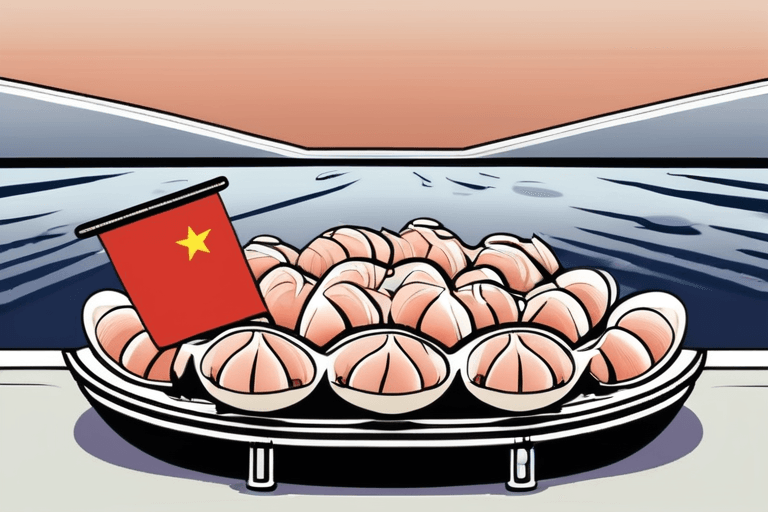
In early November, a shipment of six tons of Hokkaido scallops departed a northern Japanese port en route to China, intended as a symbol of improving relations after Beijing had lifted a long-standing ban on Japanese seafood. However, this thaw proved short-lived when Japan's prime minister signaled a willingness to defend Taiwan against China, prompting Beijing to reinstate the seafood ban, turning the Hokkaido scallop into a diplomatic bargaining chip.
The incident highlights the complex and often strained relationship between Japan and China, where economic ties are frequently interwoven with political tensions. For Beijing, the humble scallop has become a tool to exert diplomatic pressure on Tokyo. Conversely, Japan's allies have framed the consumption of Hokkaido scallops as an act of resistance against what they perceive as economic coercion by China.
Hokkaido scallops, harvested from the cold, nutrient-rich waters off Japan's northern island, are highly valued for their rich, buttery flavor and command premium prices, particularly in the Chinese market. The initial lifting of the ban was seen as a positive step for Japanese fishermen and exporters who had suffered significant economic losses due to previous trade restrictions.
The situation reflects broader geopolitical concerns in the region, particularly regarding Taiwan. China views Taiwan as a breakaway province and has not ruled out using force to unify it with the mainland. Japan, a close ally of the United States, has expressed increasing concern over China's growing military assertiveness in the region.
The renewed ban has left Japanese officials scrambling to find alternative markets for their scallops and to mitigate the economic impact on the fishing industry. Some have suggested increasing domestic consumption or seeking new export opportunities in Europe and Southeast Asia. The Japanese government is also exploring avenues for diplomatic dialogue with China to resolve the trade dispute and de-escalate tensions. The mollusk's fate remains uncertain as the diplomatic standoff continues.

















Discussion
Join the conversation
Be the first to comment