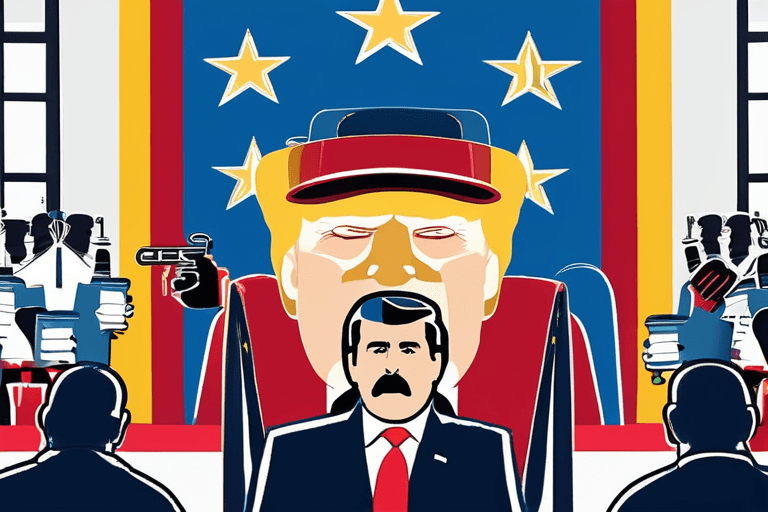
Nearly a week after former U.S. President Donald Trump announced what he described as the first U.S. ground strike in a four-month-long military pressure campaign against Venezuela, details surrounding the event remain scarce. CNN and The New York Times reported late Monday that the CIA had allegedly used a drone to target a port facility purportedly used by the Tren de Aragua street gang.
The alleged drone strike marks a significant escalation in the ongoing shadow war between the U.S. and Venezuela, a conflict rooted in years of political and economic instability within the South American nation. The U.S. has long accused Venezuelan President Nicolás Maduro of authoritarian rule, corruption, and human rights abuses, while Maduro maintains that the U.S. is attempting to destabilize his government and seize control of Venezuela's vast oil reserves.
No casualties were reported in the alleged attack, but the date, time, and location remain unknown. The Venezuelan government has yet to officially comment on the incident.
The situation unfolds against a backdrop of deep political polarization within Venezuela. While Maduro maintains a grip on power, he faces significant opposition both domestically and internationally. Protests, often met with government repression, have become a recurring feature of Venezuelan life. A photograph taken on December 22, 2025, in Caracas shows a protestor riding a motorcycle adorned with a poster of Donald Trump, highlighting the complex and often contradictory sentiments within the country.
The Tren de Aragua, the gang allegedly targeted in the drone strike, has expanded its reach throughout South America, engaging in criminal activities ranging from drug trafficking to extortion. Its presence has further destabilized the region, creating a complex security challenge for neighboring countries.
The U.S. has a long history of intervention in Latin America, often justified by the Monroe Doctrine, which asserts U.S. hegemony in the Western Hemisphere. Critics argue that such interventions have often undermined democracy and fueled instability.
U.S. wargames have reportedly played out scenarios for Maduro's fall, none of which ended well for Venezuela, according to sources familiar with the simulations. The potential for further escalation remains high, with implications for regional stability and international relations. The situation is being closely monitored by international organizations, including the United Nations and the Organization of American States, but a clear path toward de-escalation remains elusive.











Discussion
Join the conversation
Be the first to comment