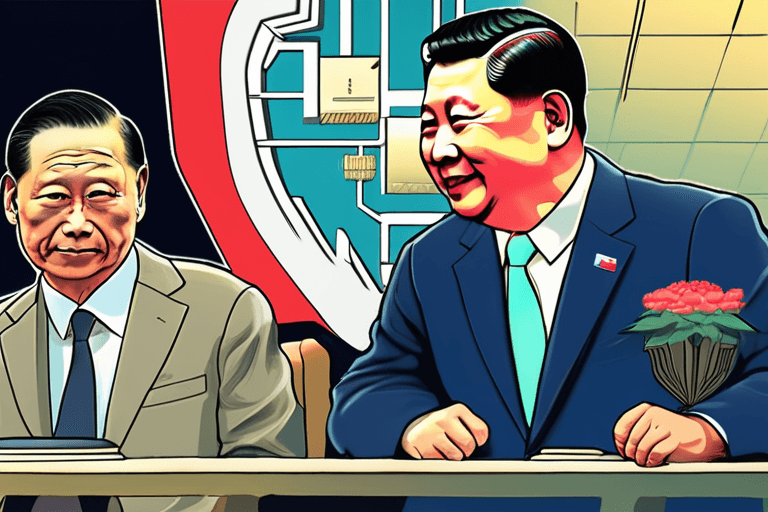
Chinese President Xi Jinping stated in his annual New Year's Eve speech that the reunification of China and Taiwan is inevitable. The declaration, made in Beijing, followed the conclusion of extensive military exercises conducted by the People's Liberation Army (PLA) around Taiwan.
Xi emphasized that the reunification of the "motherland" is a historical trend that cannot be stopped. China considers Taiwan, a self-governed island, to be a part of its territory and has consistently maintained its intention to annex it, potentially through the use of force.
These remarks come amid growing concerns within U.S. intelligence regarding China's military capabilities and its potential to launch an attack on Taiwan should Xi deem it necessary. The PLA conducted live-fire military drills on Monday and Tuesday, simulating a blockade of Taiwan's key ports, involving naval and air force assets.
The situation highlights the complex geopolitical dynamics in the region. China's stance on Taiwan is rooted in its historical narrative and its "One China" policy, which asserts that there is only one sovereign state under the name China, and Taiwan is a part of it. Taiwan, however, maintains that it is an independent and sovereign state, officially known as the Republic of China.
The United States maintains a policy of "strategic ambiguity" regarding Taiwan, neither confirming nor denying whether it would intervene militarily in the event of a Chinese attack. This policy is designed to deter both China from attacking and Taiwan from declaring formal independence.
The recent military drills and Xi's reaffirmation of reunification underscore the ongoing tensions in the Taiwan Strait. The international community is closely monitoring the situation, recognizing the potential for conflict and its broader implications for regional and global stability. Future developments will likely involve continued diplomatic efforts to manage the relationship between China and Taiwan, as well as ongoing military modernization by both sides.

















Discussion
Join the conversation
Be the first to comment