Scientists have uncovered a range of intriguing findings this month, from the biomechanics of kangaroo movement to the unearthing of an ancient seafarer's fingerprint. The discoveries also include a fossilized bird that choked to death on rocks and the observation of a double-detonating superkilonova.
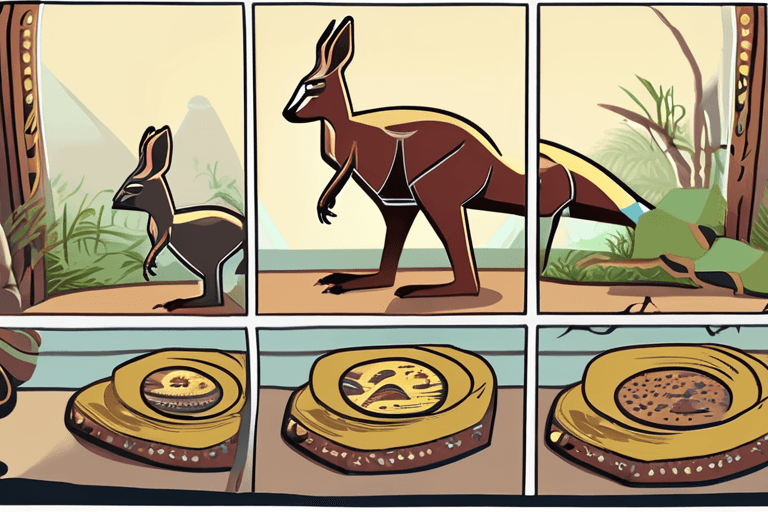
Researchers delved into the unique locomotion of kangaroos and wallabies, known as macropods, whose movement patterns differ significantly from other animals. According to a study, macropods use all four limbs and their tail for ground contact at slower speeds, transitioning to a hopping gait as speed increases. Contrary to typical expectations, high-speed movement is less energy-intensive for macropods than slow-speed motion. The research, published under a Creative Commons license, sheds light on the energy efficiency of hopping in these animals.
In another discovery, scientists recovered an ancient seafarer's fingerprint, offering a tangible connection to the past. The details of the recovery and the seafarer's identity remain limited, but the finding provides a unique glimpse into the lives of individuals from centuries ago.
Furthermore, paleontologists identified a fossilized bird that died after choking on rocks. This rare find provides insights into the feeding habits and potential hazards faced by ancient avian species. The specific species of bird and the location of the fossil discovery were not detailed.
Astronomers also reported the observation of a double-detonating superkilonova, a rare and powerful cosmic event. This type of supernova involves two separate detonations, resulting in an exceptionally bright and energetic explosion. The observation contributes to a better understanding of stellar evolution and the processes that create heavy elements in the universe.
The research also touched upon theoretical physics, with scientists making progress on a dark matter puzzle that had previously stumped fictional physicists on the television show "The Big Bang Theory." While specific details of the solution were not provided, the breakthrough highlights the ongoing efforts to understand the nature of dark matter, a mysterious substance that makes up a significant portion of the universe's mass.

















Discussion
Join the conversation
Be the first to comment