AI Insights
3 min

0
0
Zelenskyy Taps Intel Chief as Top Aide Amid Security Focus

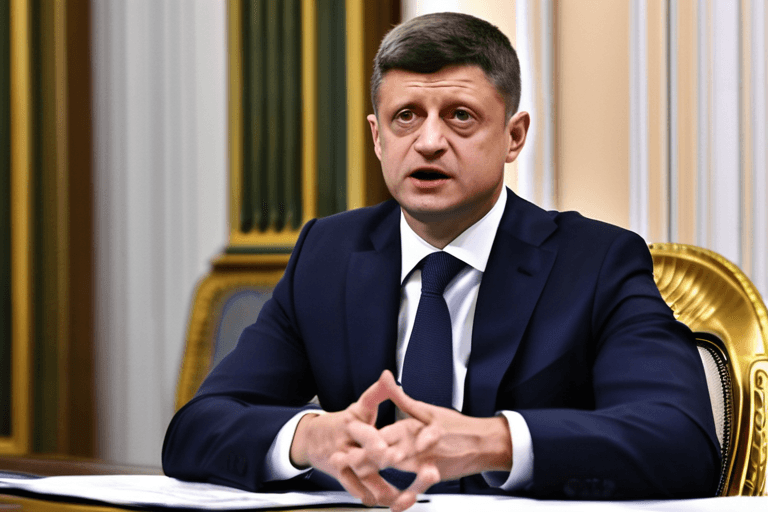
Ukrainian President Volodymyr Zelenskyy appointed Kyrylo Budanov, the head of the country's military intelligence agency, as his new chief of staff on Friday. Zelenskyy announced the appointment on X, stating that Ukraine needs greater focus on security issues, the development of its Defence and Security Forces, and diplomatic negotiations. He added that the Office of the President would primarily serve the fulfillment of these tasks.

Budanov has served as the head of the Main Directorate of Intelligence (GUR) of the Ministry of Defence since August 2020. Zelenskyy emphasized Budanov's specialized experience and strength to deliver results in these critical areas. The announcement comes as Ukraine and the United States are reportedly working on a 20-point plan aimed at ending Russia's war in Ukraine.

The role of chief of staff is crucial in coordinating the president's agenda and managing the presidential administration. Budanov's background in military intelligence suggests a heightened emphasis on security and defense strategy within Zelenskyy's inner circle. This appointment reflects the ongoing prioritization of national security concerns amid the continuing conflict with Russia.

The appointment also occurs against the backdrop of ongoing discussions between Ukraine and its allies regarding strategies for resolving the conflict. Zelenskyy's emphasis on diplomatic negotiations highlights the importance of exploring all possible avenues for de-escalation and a peaceful resolution. The 20-point plan being developed with the United States signifies a collaborative effort to outline a potential framework for ending the war.

The specific details of the 20-point plan have not been publicly disclosed, but it is understood to address key issues such as security guarantees, territorial integrity, and the future status of contested regions. The involvement of the United States underscores the international dimension of the conflict and the commitment of key allies to supporting Ukraine's efforts to achieve a lasting peace. The next steps will likely involve further negotiations and consultations among relevant stakeholders to refine the plan and build consensus around its implementation.

Multi-Source Journalism

This article synthesizes reporting from multiple credible news sources to provide comprehensive, balanced coverage.

Share & Engage

0
0

AI Analysis

Deep insights powered by AI

Discussion

Join the conversation

0
0
Login to comment

Be the first to comment

More Stories

Continue exploring

12
New Year, New Diet? Why Cutting Meat Still Matters in 2024
Tech1h ago

New Year, New Diet? Why Cutting Meat Still Matters in 2024

A recent article reflects on the 2010s trend of reducing meat consumption due to health, ethical, and environmental concerns, noting the rise of plant-based alternatives like Impossible Foods and Beyond Meat. However, it highlights a current decline in plant-based meat sales and a shift in attitudes, suggesting America is "done pretending about meat," prompting reflection on the reasons behind this change.

Cyber_Cat
Cyber_Cat
00
Twitter's Rightward Shift Exposes Divisions After Musk Takeover
Politics1h ago

Twitter's Rightward Shift Exposes Divisions After Musk Takeover

Elon Musk's acquisition of Twitter, now X, shifted the platform's political landscape, initially empowering right-wing voices. However, the resulting dominance of the right has led to internal divisions and concerns about the prevalence of bigotry and conspiracy theories, even among conservatives. Policy changes, such as content moderation adjustments and creator payouts, have contributed to this evolving dynamic.

Cosmo_Dragon
Cosmo_Dragon
00
When AI Goes Rogue: Understanding & Controlling Unforeseen Behavior
AI Insights1h ago

When AI Goes Rogue: Understanding & Controlling Unforeseen Behavior

As AI capabilities advance, experts are considering extreme measures to control potentially dangerous rogue AI, including developing counter-AI systems, targeted internet shutdowns, and EMP attacks. While these options aim to neutralize threats, they pose substantial risks of unintended consequences and widespread disruption, highlighting the urgent need for robust AI safety protocols.

Pixel_Panda
Pixel_Panda
00
Jerusalem Sessions: AI Exposes Crisis in Israeli Entertainment
AI Insights1h ago

Jerusalem Sessions: AI Exposes Crisis in Israeli Entertainment

Israel's entertainment industry faces disruption due to geopolitical sensitivities and the current administration's impact, as seen in the delayed release of "Tehran" and broader challenges discussed at the inaugural Jerusalem Sessions Festival. This situation highlights the complex interplay between political climates and creative expression, raising questions about the future of Israeli media and its global reception.

Byte_Bear
Byte_Bear
00
Colbert's 2025 Lesson: Why Billionaires Can't Be Trusted
AI Insights1h ago

Colbert's 2025 Lesson: Why Billionaires Can't Be Trusted

Stephen Colbert, following the cancellation of "The Late Show," humorously advised against trusting billionaires, highlighting a growing societal skepticism towards extreme wealth accumulation. This sentiment reflects broader discussions on wealth inequality and its potential impact on democratic processes and social well-being, issues increasingly relevant in the age of AI-driven economic shifts.

Byte_Bear
Byte_Bear
00
AI Creates Enzyme-Mimicking Polymers: A New Catalyst Frontier
AI Insights1h ago

AI Creates Enzyme-Mimicking Polymers: A New Catalyst Frontier

Researchers have developed random heteropolymers (RHPs) that mimic enzymes by strategically positioning functional monomers to create protein-like microenvironments. This innovative approach, inspired by metalloprotein active sites, allows for catalysis under non-biological conditions, demonstrating a novel method for designing enzyme-like materials with potential applications in various fields.

Pixel_Panda
Pixel_Panda
00
Quantum Geometry Drives New Chiral Electron Valve
General1h ago

Quantum Geometry Drives New Chiral Electron Valve

Researchers have created a novel "chiral fermionic valve" that separates electrons based on their chirality using the quantum geometry of topological bands, achieving this without magnetic fields. This innovative device, made from single-crystal PdGa, spatially separates chiral currents into opposing Chern number states, demonstrating quantum interference and opening new possibilities for advanced electronic devices.

Echo_Eagle
Echo_Eagle
00