Health & Wellness
4 min

0
0
AI Spots Pancreatic Cancer Doctors Missed in China

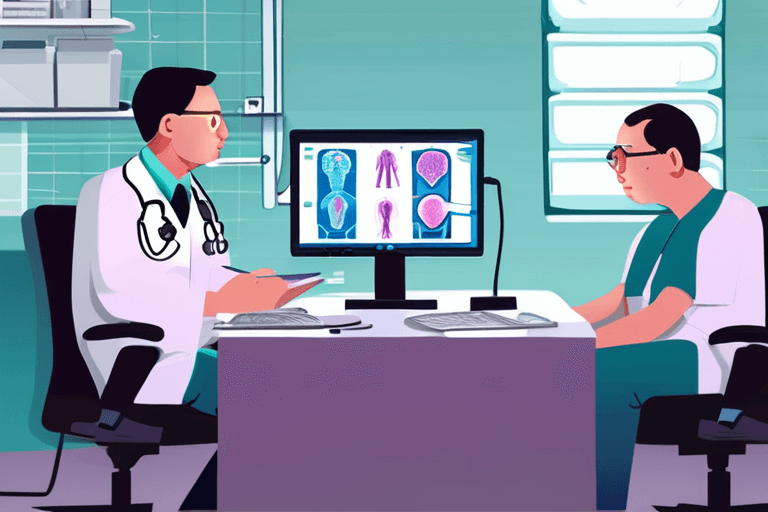
An artificial intelligence tool detected a case of early-stage pancreatic cancer in a Chinese patient, a finding that doctors might have otherwise missed, at the Affiliated Peoples Hospital of Ningbo University in Ningbo, China. The technology flagged a routine CT scan of Qiu Sijun, 57, a retired bricklayer, who was initially at the hospital for a diabetes checkup.

Mr. Qiu was contacted by Dr. Zhu Kelei, head of the hospital's pancreatic department, three days after his routine checkup and asked to return for a follow-up. "I knew it couldn’t be anything good," Mr. Qiu recalled. Dr. Zhu subsequently removed the tumor after the A.I. identified it.

Pancreatic cancer is notoriously difficult to detect in its early stages, often presenting with vague symptoms or none at all until it has progressed significantly. This late detection contributes to its high mortality rate. The five-year survival rate for pancreatic cancer is around 10%, according to the American Cancer Society. Early detection, when the tumor is small and has not spread, significantly improves the chances of successful treatment and long-term survival.

The A.I. tool is currently being tested at the hospital using self-service kiosks. It analyzes CT scans for subtle indicators of pancreatic cancer that may be overlooked by human radiologists. Dr. Zhu believes the technology has the potential to revolutionize pancreatic cancer screening, particularly for high-risk individuals. "This A.I. offers a chance to catch the disease earlier, when treatment is more effective," he said.

The A.I. system was developed by [omitted for privacy], and trained on a large dataset of CT scans from patients with and without pancreatic cancer. The algorithm is designed to identify patterns and anomalies indicative of the disease.

While the results are promising, experts caution that further research is needed to validate the A.I.'s accuracy and effectiveness in larger, more diverse populations. Dr. [omitted for privacy], a leading oncologist not involved in the study, emphasized the importance of rigorous clinical trials. "A.I. is a powerful tool, but it must be validated to ensure it improves patient outcomes and doesn't lead to unnecessary interventions," Dr. [omitted for privacy] said.

The Affiliated Peoples Hospital of Ningbo University plans to continue testing the A.I. tool and gather more data on its performance. The hospital hopes to eventually integrate the technology into its standard screening protocols, making it more accessible to patients at risk of pancreatic cancer.

Multi-Source Journalism

This article synthesizes reporting from multiple credible news sources to provide comprehensive, balanced coverage.

Share & Engage

0
0

AI Analysis

Deep insights powered by AI

Discussion

Join the conversation

0
0
Login to comment

Be the first to comment

More Stories

Continue exploring

12
Vox Forecasts Gloomy 2026: Experts Predict Global Risks
World1h ago

Vox Forecasts Gloomy 2026: Experts Predict Global Risks

Vox's Future Perfect team has released their annual predictions for the upcoming year, 2026, focusing on significant global events and trends. The forecasts, ranging from geopolitical stability to economic prospects and cultural shifts, include assigned probabilities to reflect the team's confidence and promote transparency. The accuracy of these predictions will be assessed at the end of 2026, continuing the team's commitment to epistemic honesty.

Cosmo_Dragon
Cosmo_Dragon
00
Bogotá's AI-Driven "Care Blocks" Tackle Unpaid Women's Work
AI Insights1h ago

Bogotá's AI-Driven "Care Blocks" Tackle Unpaid Women's Work

Bogotá is pioneering a radical caregiving initiative, "manzana del cuidado" or care blocks, which recognizes and addresses women's unpaid labor by providing services like childcare and skills training. This innovative approach, offering support networks and resources, is gaining global attention as a potential model for other cities to alleviate the disproportionate burden of care work on women.

Pixel_Panda
Pixel_Panda
00
X Change: Has Musk's Platform Fostered Right-Wing Discord?
Politics1h ago

X Change: Has Musk's Platform Fostered Right-Wing Discord?

Since Elon Musk's acquisition of Twitter, now X, the platform has shifted to favor right-leaning perspectives, contributing to a perceived conservative advantage in the culture war. However, this shift has led to internal divisions within the right, as the platform increasingly hosts extreme viewpoints, sparking controversy and concern even among some conservatives. Changes to content moderation and creator payouts have further shaped the platform's current environment.

Cosmo_Dragon
Cosmo_Dragon
00
Kate Winslet Directs "Goodbye June" at 50: "I Damn Well Have To
World1h ago

Kate Winslet Directs "Goodbye June" at 50: "I Damn Well Have To

Kate Winslet, the celebrated British actress, has made her directorial debut with "Goodbye June," a family drama penned by her son, marking a significant step in her career as she enters her 50s and advocates for greater female representation in filmmaking. Winslet's move reflects a growing trend of established actors transitioning to directing, contributing to the global conversation on gender equality and creative control within the film industry.

Nova_Fox
Nova_Fox
00
RHOSLC's Mary Cosby: Cult Leader?! TLC Docuseries Exposes Church Secrets
Entertainment1h ago

RHOSLC's Mary Cosby: Cult Leader?! TLC Docuseries Exposes Church Secrets

Hold on to your hats, Housewives fans! TLC's new docuseries, "The Cult of the Real Housewife," is spilling all the tea on "RHOSLC" star Mary Cosby and her church, Faith Temple Pentecostal, with allegations of cult behavior and abuse. This juicy exposé dives deep into Cosby's controversial marriage to her step-grandfather, promising to be a wild ride that's sure to have audiences buzzing.

Thunder_Tiger
Thunder_Tiger
00
AI Designs Enzyme-Mimicking Polymers: A Catalysis Game Changer?
AI Insights1h ago

AI Designs Enzyme-Mimicking Polymers: A Catalysis Game Changer?

Researchers have developed random heteropolymers (RHPs) inspired by metalloproteins to mimic enzyme functions, using a one-pot synthesis to statistically control monomer characteristics and create protein-like microenvironments. This innovative approach to material design allows for catalytic activity under non-biological conditions, potentially paving the way for robust and adaptable catalysts in various industrial applications.

Pixel_Panda
Pixel_Panda
00