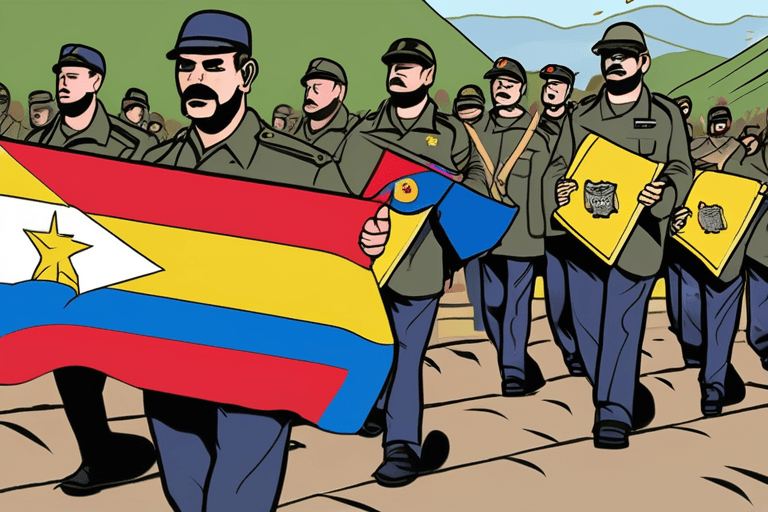
U.S. strikes on Venezuela prompted a range of reactions across Latin America, with some nations expressing concern over the escalation of tensions and others voicing support for the U.S. action. The strikes, which took place on January 3, 2026, targeted alleged drug trafficking and terrorist training camps within Venezuelan territory, according to U.S. officials.
Venezuela's President Nicolas Maduro condemned the strikes as a violation of international law and an act of aggression against his country's sovereignty. "These attacks are an unacceptable assault on our nation and a clear attempt to destabilize our government," Maduro stated in a televised address. He vowed to defend Venezuela's territorial integrity and called for an emergency meeting of the Union of South American Nations (UNASUR).
Brazil's foreign ministry issued a statement expressing "grave concern" over the U.S. military action, emphasizing the importance of peaceful resolution of disputes and respect for national sovereignty. "Brazil believes that dialogue and diplomacy are the only viable paths to resolving the complex challenges facing the region," the statement read.
In contrast, Colombia's government, a close ally of the United States, expressed its support for the strikes. President Ivan Duque stated that Venezuela had become a haven for criminal organizations and that the U.S. action was necessary to combat drug trafficking and terrorism. "Colombia stands with the United States in its efforts to protect regional security and stability," Duque said.
The strikes occurred against a backdrop of increasing political and economic instability in Venezuela. Years of economic mismanagement, corruption, and authoritarian rule have led to widespread poverty, hyperinflation, and a mass exodus of Venezuelans to neighboring countries. The United States has long accused the Maduro government of human rights abuses, drug trafficking, and supporting terrorist groups.
According to NPR international correspondent Eyder Peralta, the U.S. strikes have further polarized the region, with some countries fearing a wider conflict. "There is a real concern that this could escalate into a regional crisis," Peralta said. "Many countries in Latin America are wary of U.S. intervention and prefer to see a negotiated solution to the Venezuelan crisis."
Daniel Estrin, also an NPR correspondent, noted that the strikes could strengthen Maduro's grip on power by allowing him to rally support against a perceived external threat. "Maduro has long used anti-imperialist rhetoric to deflect criticism of his government," Estrin explained. "This action by the U.S. could play into his hands."
The Organization of American States (OAS) is scheduled to hold an emergency session to discuss the situation in Venezuela. The outcome of that meeting and the response from other international actors will likely determine the next steps in this unfolding crisis. The long-term implications of the U.S. strikes on Venezuela for regional stability and U.S.-Latin American relations remain to be seen.













Discussion
Join the conversation
Be the first to comment