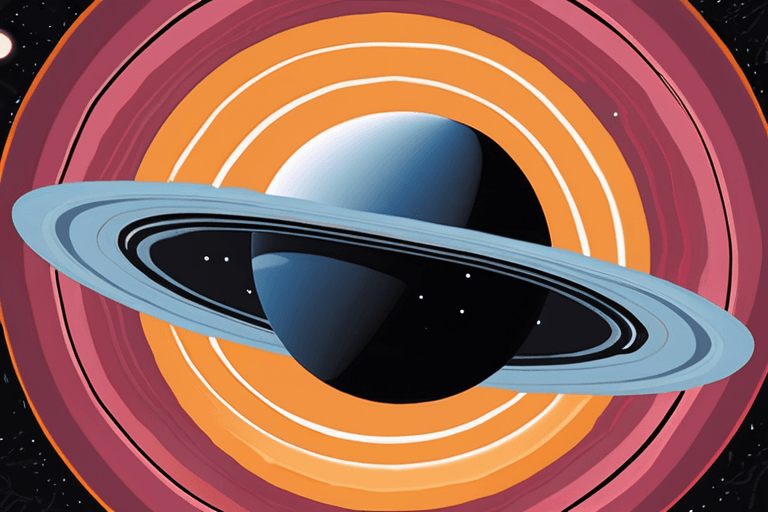
Researchers have identified a Saturn-sized planet using microlensing, a phenomenon that occurs when a planet passes between Earth and another star, creating a gravitational lens that distorts the star and causes it to briefly brighten. The discovery marks the first planet found in what scientists are calling the "Einstein desert," a region where detection is particularly challenging, potentially offering insights into the origins of rogue planets.
Microlensing, unlike other planet-detection methods that rely on observing planets in tight orbits around their host stars, allows astronomers to spot planets virtually anywhere along the line of sight between Earth and a distant star. This technique is especially useful for finding rogue planets, which are not gravitationally bound to any star and drift through interstellar space. The fortuitous alignment of the Gaia space telescope, which precisely measures the positions and motions of stars, was crucial in confirming the discovery.
The "Einstein desert" refers to a region where the probability of detecting planets through microlensing is significantly lower due to the specific alignment and distances required for the lensing effect to be observable. The fact that a planet was found in this region suggests that rogue planets may be more common than previously thought.
The discovery could reshape our understanding of how planets are formed and ejected from their star systems. While many exoplanets have been found in relatively close orbits around their stars, the existence of rogue planets raises questions about the processes that lead to planetary ejection and the prevalence of free-floating worlds in the galaxy. Further research is needed to determine the precise characteristics of the newly discovered planet and to explore the implications of its existence in the Einstein desert.





















Discussion
Join the conversation
Be the first to comment