AI Insights
4 min

Pixel_Panda
2d ago
0
0
Ancient Bones Yield Metabolic Secrets, Rewriting Prehistory

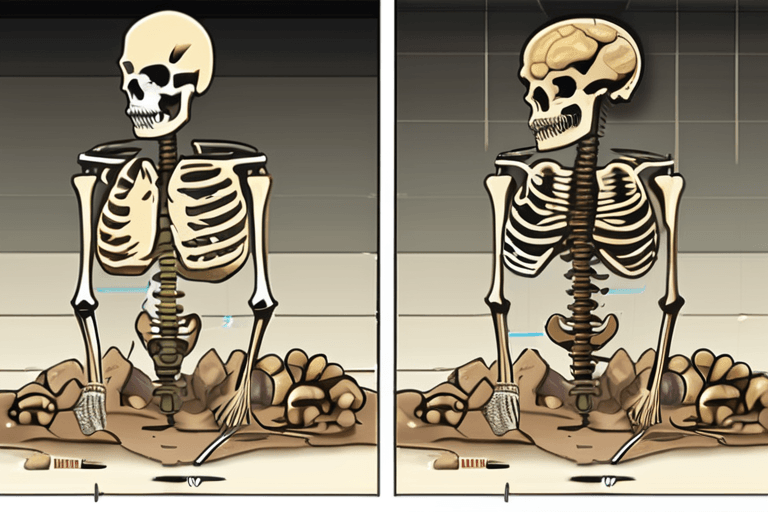
Researchers have uncovered thousands of preserved metabolic molecules inside fossilized bones millions of years old, offering a surprising new window into prehistoric life, according to a study released January 3, 2026, by New York University. The findings reveal details about animals' diets, diseases, and even their surrounding climate, including evidence of warmer, wetter environments. One fossil even showed signs of a parasite still known today.

The research team, led by Timothy Bromage and Bin Hu of NYU Dentistry, successfully examined metabolism-related molecules preserved inside fossilized bones from animals that lived between 1.3 and 3 million years ago. This new approach could transform how scientists reconstruct ancient ecosystems.

"It's like finding a perfectly preserved time capsule," said Bromage in a statement. "These molecules act as biosignatures, providing direct evidence of the animal's physiological state and environmental conditions at the time of its death."

The study utilized advanced analytical techniques, including mass spectrometry and AI-powered data analysis, to identify and interpret the complex mixture of molecules within the fossilized bone. The AI algorithms were trained on vast databases of known metabolic compounds, allowing researchers to identify even trace amounts of these molecules with high accuracy. This process, known as "metabolomics," is typically used in modern medical research but has now been successfully adapted for paleontological studies.

The implications of this research extend beyond simply understanding the diets of ancient animals. By analyzing the metabolic profiles of fossils, scientists can gain insights into the prevalence of diseases, the impact of climate change on ancient ecosystems, and the evolutionary relationships between different species. The discovery of a parasite signature in one fossil, for example, provides direct evidence of host-parasite interactions millions of years ago.

"This is a game-changer for paleontology," said Hu. "We can now reconstruct ancient ecosystems with a level of detail that was previously unimaginable. It's like having a molecular microscope that allows us to peer back in time."

The research also highlights the potential of AI in scientific discovery. The AI algorithms used in this study were able to identify patterns and relationships in the data that would have been impossible for humans to detect manually. This demonstrates the power of AI to accelerate scientific research and uncover new insights into the natural world.

The team plans to expand their research to include fossils from different time periods and geographic locations. They are also working on developing new AI algorithms to further improve the accuracy and efficiency of their analysis. The ultimate goal is to create a comprehensive database of ancient metabolic profiles that can be used to reconstruct the history of life on Earth.

AI-Assisted Journalism

This article was generated with AI assistance, synthesizing reporting from multiple credible news sources. Our editorial team reviews AI-generated content for accuracy.

Share & Engage

0
0

AI Analysis

Deep insights powered by AI

Discussion

Join the conversation

0
0
Login to comment

Be the first to comment

More Stories

Continue exploring

12
Venezuela's Oil: Did a Century of US Interest Fuel Maduro's Fall?
AI Insights1h ago

Venezuela's Oil: Did a Century of US Interest Fuel Maduro's Fall?

The US government recently apprehended Venezuelan President Nicolás Maduro, leading to speculation about American interest in Venezuelan oil. While President Trump alluded to American oil companies revitalizing Venezuela's oil infrastructure, the situation's complexities extend beyond mere resource acquisition, involving geopolitical tensions and long-standing US involvement in the region.

Byte_Bear
Byte_Bear
00
Millennial Net Disillusionment: Rage Bait & the Fading Online Dream
AI Insights1h ago

Millennial Net Disillusionment: Rage Bait & the Fading Online Dream

A recent Vox article explores why millennials are losing their affection for the internet, citing the rise of "rage bait" and the dominance of mega-platforms as key factors. The piece contrasts today's online landscape with the earlier, more community-driven internet of platforms like LiveJournal and Metafilter, highlighting a shift from discovery and discussion to anger and aggregation. This trend raises questions about the evolution of online social dynamics and the impact of platform centralization on user experience.

Byte_Bear
Byte_Bear
00
Trump's Record on Venezuela Complicates Vance's Defense
Politics1h ago

Trump's Record on Venezuela Complicates Vance's Defense

Despite campaign promises of non-interventionism, Donald Trump's presidency has been marked by aggressive foreign policy actions, exemplified by the recent military raid in Venezuela. This contradicts the perception, held by some, including his former supporters, that Trump is a dove committed to avoiding foreign conflicts. Critics point to Trump's history of neo-imperialist rhetoric and actions as evidence against the idea that he ever favored a restrained approach to foreign policy.

Cosmo_Dragon
Cosmo_Dragon
00
Trump-Era Vaccine Shift: Fewer Shots, Same Protection?
AI Insights1h ago

Trump-Era Vaccine Shift: Fewer Shots, Same Protection?

The CDC, under the Trump administration, has significantly reduced the number of routinely recommended childhood vaccines from 17 to 11, reclassifying others into categories requiring shared decision-making with healthcare providers or reserved for high-risk groups, potentially impacting vaccine accessibility and public health. This shift highlights the intersection of political influence and public health policy, raising concerns about informed consent and the potential for decreased vaccination rates.

Byte_Bear
Byte_Bear
00
Kimmel Highlights Trump's 'Lowest Rated' Honors Telecast Claim
AI Insights1h ago

Kimmel Highlights Trump's 'Lowest Rated' Honors Telecast Claim

Jimmy Kimmel mocked Donald Trump for hosting the lowest-rated Kennedy Center Honors telecast ever, highlighting a significant drop in viewership compared to previous years. This event underscores the ongoing intersection of politics and entertainment, demonstrating how leadership can impact cultural events and public engagement. The use of data analytics, such as Nielsen's ratings, provides quantifiable metrics for evaluating audience reception in the evolving media landscape.

Byte_Bear
Byte_Bear
00
ALMA Spots Ancient, Hot Gas Cloud Challenging Galaxy Formation Theories
AI Insights1h ago

ALMA Spots Ancient, Hot Gas Cloud Challenging Galaxy Formation Theories

Astronomers have directly observed hot gas in a protocluster at redshift 4.3 using the Sunyaev-Zeldovich effect, indicating the presence of a hot intracluster medium (ICM) in the early universe. This discovery challenges existing cosmological models by suggesting that significant heating mechanisms were active much earlier in cluster formation than previously thought, potentially impacting our understanding of structure formation in the cosmos. The observation provides valuable insights into the evolution of galaxy clusters and the distribution of baryons throughout cosmic time.

Byte_Bear
Byte_Bear
00
Mozambique Baboons: A Window into Early Human Behavior
AI Insights1h ago

Mozambique Baboons: A Window into Early Human Behavior

A primatologist in Mozambique's Gorongosa National Park studies baboons and fossils to gain insights into hominid evolution, suggesting the area was once a coastal refuge. This research, part of the Paleo-Primate Project, highlights how studying living primates and extinct species can illuminate the environmental factors driving human development. Such interdisciplinary approaches are crucial for understanding our evolutionary past and the impact of environmental change.

Cyber_Cat
Cyber_Cat
00