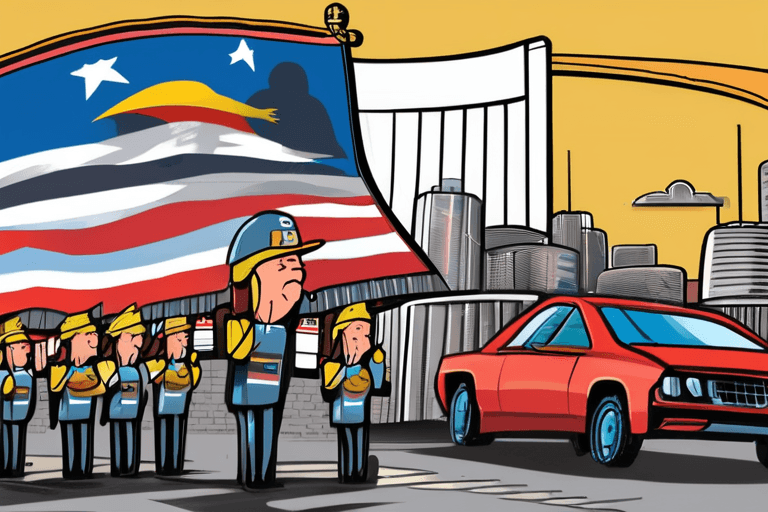
Following U.S. strikes that resulted in the capture of Venezuelan President Nicolas Maduro, U.S. President Donald Trump stated that the U.S. would "run" Venezuela until a "safe, proper and judicious transition" could be ensured. Trump further asserted that U.S. oil companies would repair Venezuela's "broken infrastructure" and "start making money for the country."
The U.S. military operation, which took place on Saturday morning, led to the capture of Maduro and his wife, First Lady Cilia Flores. The pair were transported from Caracas via U.S. helicopter to the USS Iwo Jima in the Caribbean Sea. Subsequently, they were flown to Guantanamo Bay Naval Base in Cuba before being transferred to New York state and ultimately taken to the Metropolitan Detention Center in Brooklyn, New York.
Venezuela's vice president announced a state of national emergency, denouncing the U.S. action as "military aggression" and maintaining that Maduro remained the country's legitimate leader.
The intervention marks a significant escalation in the long-standing tensions between the U.S. and Venezuela. Relations have been strained for years, particularly since the rise of Hugo Chavez and the subsequent adoption of socialist policies, including nationalization of key industries. The U.S. has long accused Maduro's government of corruption, human rights abuses, and economic mismanagement, leading to widespread poverty and a humanitarian crisis.
Venezuela possesses the world's largest proven oil reserves, but its oil production has plummeted in recent years due to underinvestment, corruption, and U.S. sanctions. The country's economic woes have fueled political instability and mass migration, impacting neighboring countries in Latin America and the Caribbean.
The U.S. intervention has drawn condemnation from some international actors, who view it as a violation of Venezuela's sovereignty and a breach of international law. Critics argue that such actions undermine multilateralism and could set a dangerous precedent for intervention in other countries. Other nations, however, have expressed support for the U.S. action, citing the need to restore democracy and stability in Venezuela.
The future of Venezuela remains uncertain. The U.S. has not yet outlined a detailed plan for the "transition" it envisions, nor has it specified the role U.S. oil companies would play in rebuilding the country's oil infrastructure. The situation is likely to be further complicated by internal divisions within Venezuela and the potential for resistance to U.S. control. The international community is closely watching developments, with many calling for a peaceful and negotiated solution to the crisis.















Discussion
Join the conversation
Be the first to comment