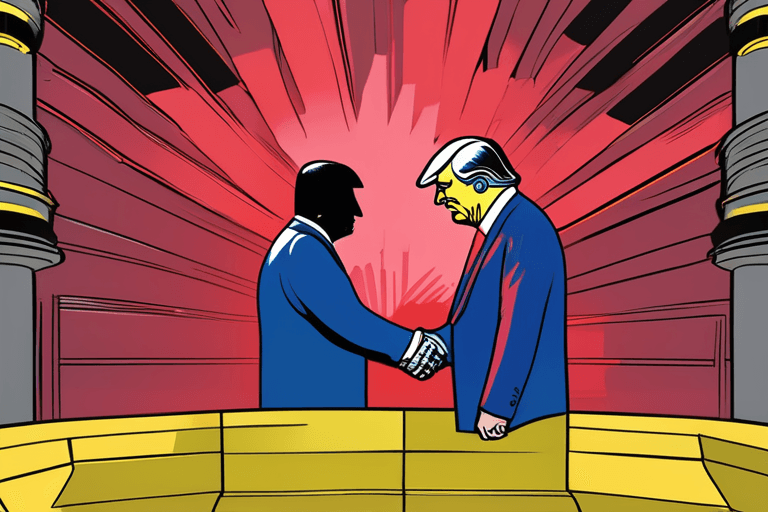
President Donald Trump's unexpected announcement that the U.S. intends to "run Venezuela" has created widespread uncertainty regarding the nation's leadership and future governance. The declaration came hours after ousted Venezuelan President Nicolás Maduro, an indicted prisoner, was reportedly en route to New York.
According to sources, Vice President Delcy Rodríguez, whom Trump suggested would collaborate with Washington, condemned the intervention as a "barbaric" kidnapping. The White House has released limited information about the specifics of managing the oil-producing nation of approximately 30 million people.
A U.S. official indicated that Secretary of State Marco Rubio, a long-time critic of Maduro and his predecessor Hugo Chavez, would assume a leading role in the administration's efforts. As of now, there are no explicit plans for deploying American troops or administrators to Venezuela.
Trump emphasized the importance of Venezuela's petroleum resources, stating that the U.S. would maintain a presence in the country related to oil. This could potentially lead to an expanded role for Chevron Corp., which currently operates in Venezuela under sanctions waivers, as well as other major American oil companies.
The situation raises complex questions about international law, national sovereignty, and the potential impact on Venezuela's economy and political stability. The U.S. intervention also highlights the growing influence of artificial intelligence in geopolitical strategies. AI algorithms can analyze vast amounts of data to predict potential outcomes, assess risks, and optimize resource allocation. This technology could be used to inform decision-making processes related to Venezuela's governance and economic development.
However, the use of AI in international affairs also raises ethical concerns. Algorithmic bias, lack of transparency, and the potential for unintended consequences are all factors that need to be carefully considered. It is crucial to ensure that AI systems are used responsibly and ethically, with human oversight and accountability.
The current status of Venezuela's leadership remains unclear, and the next steps for the U.S. intervention are yet to be determined. The situation is likely to evolve rapidly, and further developments are expected in the coming days and weeks.
















Discussion
Join the conversation
Be the first to comment