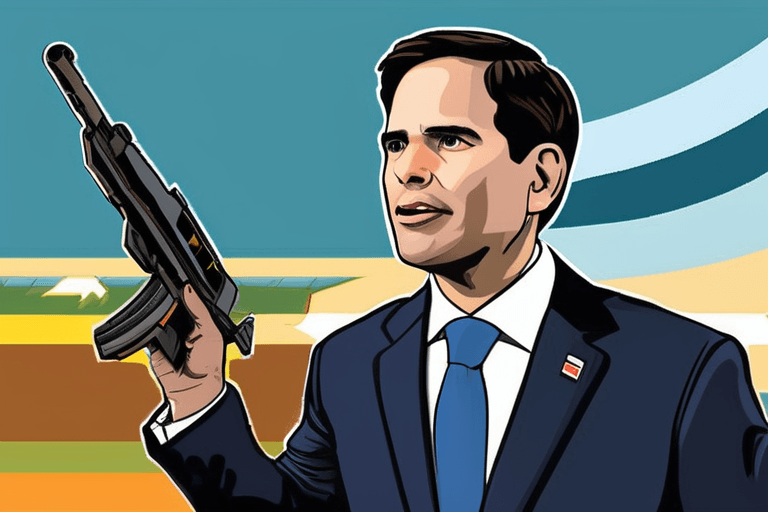
U.S. Senator Marco Rubio stated that the United States does not require Venezuelan oil but aims to prevent adversarial nations from controlling it, while also not dismissing the possibility of occupying the country. Rubio's comments, made during an interview on NBC's "Meet the Press," came in response to questions about the U.S.'s interest in Venezuela's oil industry following statements by President Donald Trump regarding U.S. oil companies investing in the country's energy infrastructure.
Rubio emphasized that the U.S. possesses sufficient oil reserves. "We don't need Venezuela's oil. We have plenty of oil in the United States," he said. His primary concern, he explained, was preventing countries like Russia, China, and Iran from dominating Venezuela's oil sector. "What we're not going to allow is for the oil industry in Venezuela to be controlled by adversaries of the United States," Rubio asserted, framing the issue as a matter of regional security within the Western Hemisphere. "This is the Western Hemisphere. This is where we live. And we're not going to allow the Western Hemisphere to be a base of operations for adversaries, competitors, and rivals of the United States, simple as that."
Venezuela holds the world's largest proven oil reserves, but its production has significantly declined due to years of mismanagement and political instability under the leadership of Nicolas Maduro. The country's economic crisis has led to widespread shortages of basic goods and services, prompting millions of Venezuelans to flee the country, creating a regional refugee crisis.
The U.S. has long been involved in Venezuelan politics, particularly concerning its oil resources. During the Trump administration, the U.S. recognized opposition leader Juan Guaidó as the interim president of Venezuela, imposing sanctions aimed at ousting Maduro and restoring democracy. However, Maduro has remained in power, backed by the military and supported by countries like Russia and China.
The potential for U.S. intervention in Venezuela has drawn international criticism, with some countries expressing concerns about sovereignty and the use of force. Latin American nations, in particular, have historically been wary of U.S. involvement in the region, recalling instances of intervention during the Cold War. The Organization of American States (OAS) has played a role in mediating the Venezuelan crisis, but divisions among member states have hindered efforts to find a resolution.
While Rubio did not explicitly detail the circumstances under which the U.S. might occupy Venezuela, his remarks suggest that the option remains on the table as a means of preventing adversarial control over the country's oil resources. The situation in Venezuela remains volatile, with ongoing political and economic challenges and the potential for further international involvement. The U.S. continues to monitor the situation closely, weighing its options and considering the broader implications for regional stability and its own strategic interests.
















Discussion
Join the conversation
Be the first to comment