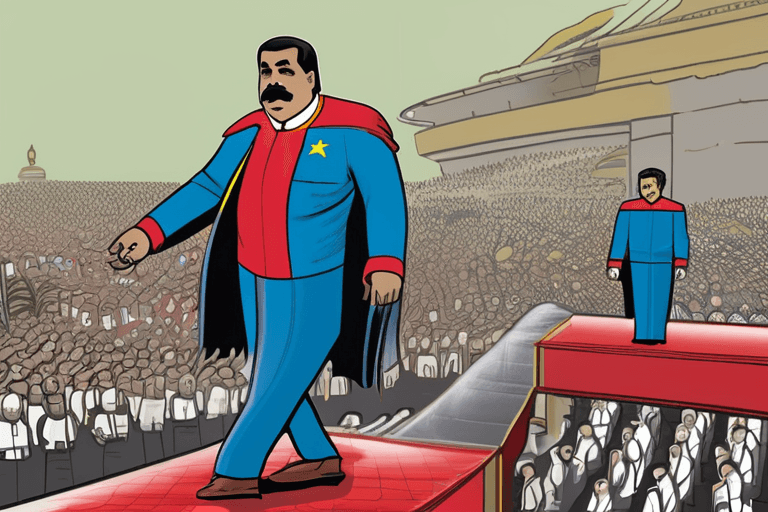
Global uncertainty surrounded the leadership of Venezuela over the weekend following a military action by the United States in Caracas that resulted in the capture of President Nicolás Maduro. The move has left the Venezuelan opposition in a state of limbo as international actors grapple with the rapidly evolving situation.
President Trump announced in a Saturday press conference that the United States would effectively govern Venezuela during a transitional period. "We are going to run the country until we can do a safe, proper and judicious transition," Trump stated, adding that Delcy Rodríguez, Maduro's vice president, had been sworn in as interim president. He portrayed Rodríguez as a cooperative partner in this endeavor, stating, "She's essentially willing to do what we think is necessary to make Venezuela great again." The Venezuelan Supreme Court subsequently confirmed Rodríguez's inauguration as acting president.
The intervention marks a significant escalation in the long-strained relationship between the United States and Venezuela. For years, the U.S. has levied sanctions against the Maduro regime, accusing it of corruption, human rights abuses, and undermining democratic institutions. Maduro, in turn, has consistently accused the U.S. of imperialist designs on Venezuela's vast oil reserves.
The situation presents a complex challenge for the international community. While some nations may view the U.S. action as a necessary step to restore democracy and stability in Venezuela, others are likely to condemn it as a violation of international law and national sovereignty. The response from key regional players in Latin America, as well as global powers like China and Russia, will be crucial in shaping the future of Venezuela.
The lack of clarity surrounding the future of Venezuela's political landscape has created a power vacuum, leaving the opposition scrambling to understand its role in the new order. The opposition, which has been fractured and largely marginalized under Maduro's rule, now faces the challenge of navigating a political landscape heavily influenced by external forces. The immediate future of Venezuela remains uncertain, with the international community closely watching developments as the U.S. attempts to implement its transition plan.












Discussion
Join the conversation
Be the first to comment