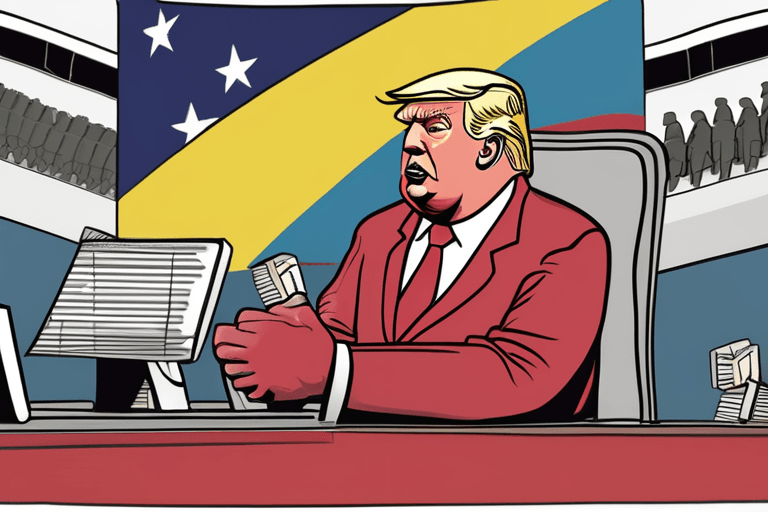
A tense calm settled over Caracas as dawn broke on January 3, 2026. But the silence was deceptive. Hours earlier, the world watched in stunned disbelief as news broke: US forces had captured Venezuelan President Nicolás Maduro in a daring military operation. President Trump, in a televised address, confirmed Maduro was en route to New York, setting the stage for what many saw as an unprecedented international crisis. But how did we get here? What chain of events led to this dramatic intervention?
The seeds of this confrontation were sown long before the predawn raids. For months, tensions between the US and Venezuela had been simmering, fueled by accusations of election fraud, human rights abuses, and Maduro's increasingly authoritarian rule. The US, under President Trump, had steadily ratcheted up economic sanctions, hoping to cripple Maduro's regime and force democratic reforms. These sanctions, however, had a devastating impact on the Venezuelan people, exacerbating an already dire humanitarian crisis.
The situation escalated rapidly in late 2025. US intelligence, relying heavily on advanced AI-powered surveillance systems, claimed to have uncovered irrefutable evidence of Maduro's involvement in drug trafficking and support for terrorist organizations. These AI systems, capable of analyzing vast amounts of data from satellite imagery, social media, and intercepted communications, provided a level of detail previously unimaginable. However, critics questioned the reliability of these AI-driven assessments, pointing to the potential for bias and errors in the algorithms.
"The problem with relying solely on AI for intelligence gathering is that it can create an echo chamber," explained Dr. Anya Sharma, a leading expert in AI ethics at Stanford University. "If the AI is trained on data that already reflects a certain bias, it will only amplify that bias in its analysis. We need human oversight to ensure that these systems are used responsibly and ethically."
The alleged evidence, however, was enough for the Trump administration. Citing the need to protect US national security and promote democracy in the region, President Trump authorized a military operation to capture Maduro. The operation, reportedly planned with the aid of sophisticated AI-powered war-gaming simulations, involved a combination of air strikes and special forces raids.
The capture of Maduro sent shockwaves through the international community. Some hailed it as a victory for democracy and a blow against tyranny. Others condemned it as a blatant violation of international law and an act of aggression. The United Nations Security Council convened an emergency session, but was deadlocked on a resolution condemning the US action.
The implications of this event are far-reaching. It raises fundamental questions about the role of AI in international relations, the limits of national sovereignty, and the future of US foreign policy. Will this action set a precedent for future interventions? Will it lead to further instability in the region? Only time will tell. But one thing is certain: the capture of Nicolás Maduro marks a turning point in the 21st century, a moment when the power of AI and the ambition of nations collided with dramatic and unpredictable consequences.














Discussion
Join the conversation
Be the first to comment