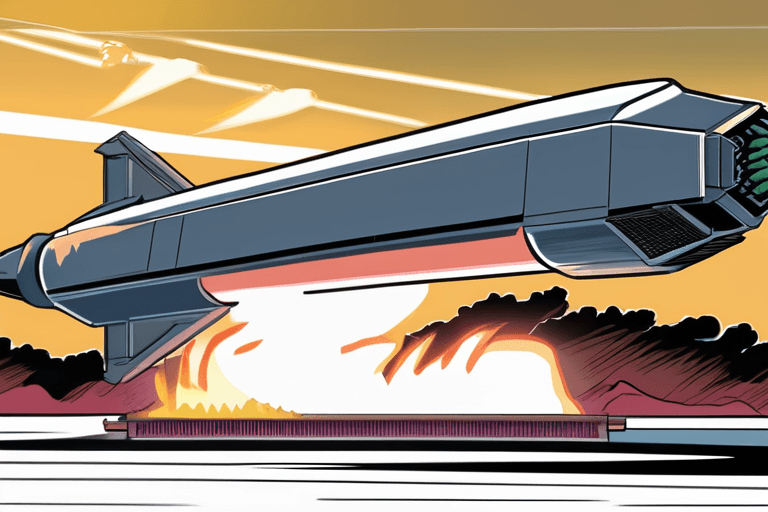
North Korean leader Kim Jong Un supervised test flights of hypersonic missiles, state media reported Monday, citing the need to strengthen the nation's nuclear capabilities in light of current geopolitical instability and complex international affairs. The Korean Central News Agency (KCNA) confirmed the drills, which occurred a day after neighboring countries detected multiple ballistic missile launches.
The missile tests took place hours before South Korean President Lee Jae Myung's scheduled departure for China to meet with President Xi Jinping. The timing of the launches has raised concerns about regional stability and the potential impact on diplomatic relations.
Hypersonic missiles are designed to travel at speeds of at least five times the speed of sound, making them difficult to intercept. North Korea's pursuit of this technology is viewed by many international observers as a direct challenge to existing missile defense systems in the region, particularly those of South Korea and Japan, both key U.S. allies.
The development and testing of such advanced weaponry by North Korea is a violation of existing United Nations Security Council resolutions, which prohibit the country from conducting ballistic missile activities. These resolutions were imposed in response to North Korea's nuclear weapons program and its continued development of long-range missiles capable of reaching targets in the United States.
The geopolitical crisis cited by Kim Jong Un is likely a reference to the ongoing tensions in the region, including the increased military presence of the United States and its allies, as well as the stalled denuclearization talks between North Korea and the U.S. The "complicated international events" could encompass a range of global issues, including the conflicts in Ukraine and the Middle East, which have diverted international attention and resources.
Analysts suggest that North Korea's actions are aimed at increasing its leverage in future negotiations with the United States and other countries. By demonstrating its military capabilities, North Korea seeks to be recognized as a nuclear power and to secure concessions, such as sanctions relief and security guarantees.
The international community has condemned North Korea's missile launches, with calls for the country to return to dialogue and abide by its international obligations. The United States, South Korea, and Japan have pledged to enhance their security cooperation and maintain a strong deterrent posture in the region. The United Nations Security Council is expected to discuss the latest developments and consider further measures to address North Korea's continued violations of international law.

















Discussion
Join the conversation
Be the first to comment