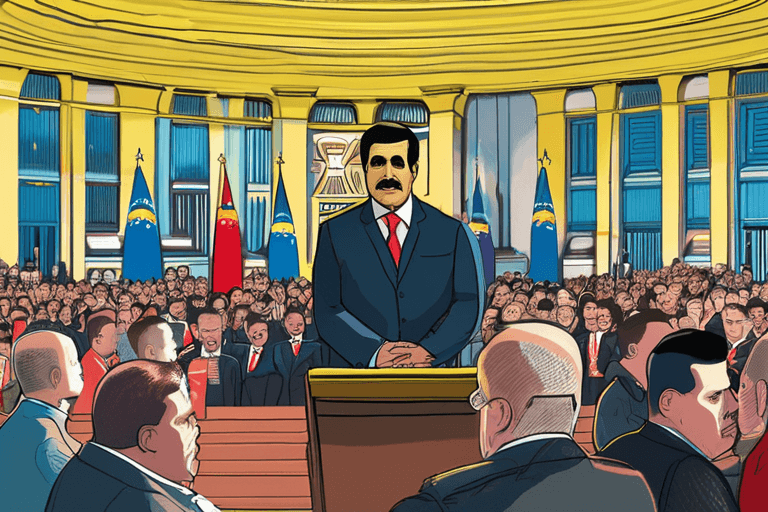
Venezuelan Defense Minister Vladimir Padrino Lopez denounced the United States' seizure of President Nicolas Maduro as a "cowardly kidnapping" on Sunday, adding that some of Maduro's bodyguards, military personnel, and civilians were killed. The statement, delivered in a televised address, followed the U.S. government's action against Maduro, which has ignited mixed reactions within Venezuela and drawn international condemnation.
Padrino Lopez also announced his endorsement of a Supreme Court ruling that appointed Vice President Delcy Rodriguez as acting president for a 90-day period. Rodriguez, who also serves as oil minister, now faces the challenge of leading a nation grappling with political instability and economic hardship.
The U.S. action against Maduro comes after years of strained relations between Washington and Caracas. The U.S. has long accused Maduro's government of corruption, human rights abuses, and undermining democracy. These accusations have been consistently rejected by Maduro, who maintains that he is the victim of U.S. imperialism and interference in Venezuela's internal affairs. The U.S. has not yet issued a formal statement beyond President Trump's threat that Rodriguez will "pay a very big price" if she doesn't cooperate with Washington.
The situation in Venezuela is further complicated by the country's deep economic crisis, marked by hyperinflation, shortages of food and medicine, and widespread poverty. This crisis has led to a mass exodus of Venezuelans seeking refuge in neighboring countries and beyond, creating a regional humanitarian challenge.
The U.S. action and the subsequent appointment of Rodriguez as acting president have triggered a range of reactions from the international community. Some nations have expressed support for the U.S. intervention, arguing that it is necessary to restore democracy in Venezuela. Others have condemned the move as a violation of international law and an infringement on Venezuela's sovereignty.
The current crisis also raises questions about the future of Venezuela's oil industry, which is a crucial source of revenue for the country. With Rodriguez now at the helm, it remains to be seen whether she will be able to stabilize the economy and address the pressing needs of the Venezuelan people. The next few weeks will be critical in determining the direction of Venezuela's political landscape and its relationship with the international community.
















Discussion
Join the conversation
Be the first to comment