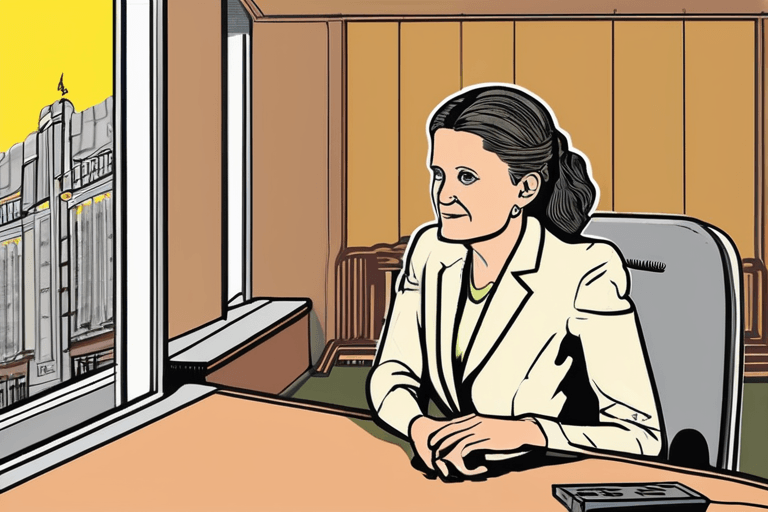
In a move signaling Ukraine's intent to aggressively pursue postwar economic revitalization, President Volodymyr Zelensky has tapped former Canadian Deputy Prime Minister Chrystia Freeland as an adviser on economic development. The appointment, announced Monday, brings a seasoned political figure with deep ties to the West into the Ukrainian fold, tasked with navigating the complex landscape of attracting foreign investment and shaping economic reforms.
Freeland's arrival comes at a pivotal moment for Ukraine. With the conflict still raging, the nation is already looking ahead to the immense challenge of rebuilding its shattered infrastructure and revitalizing its economy. Zelensky, in his statement, emphasized Freeland's expertise in these areas, specifically citing her ability to attract foreign investment and her understanding of economic reform. He indicated that her advisory role would extend to postwar reconstruction efforts, contingent upon the success of ongoing peace negotiations.
While Zelensky lauded Freeland's "professional command of economic policy," details regarding the specifics of her role remain somewhat sparse. This ambiguity has fueled speculation about the precise nature of her responsibilities and the extent of her influence within the Ukrainian government. The appointment marks the first instance during the war of such a high-profile Western politician being brought into a formal government position, underscoring the significance Ukraine places on international economic collaboration.
The timing of Freeland's appointment coincides with proposals from the Trump administration for a substantial U.S. role in Ukraine's postwar reconstruction. Zelensky recently alluded to a draft settlement agreement that envisions the creation of U.S.-controlled investment funds, potentially worth hundreds of billions of dollars. These funds would reportedly draw on frozen Russian central bank assets, a significant portion of which are currently held in Belgium, as well as on European Union reconstruction financing. The allocation of these funds, as proposed, would be overseen by U.S. entities, a prospect that has generated both interest and debate within international financial circles.
"The appointment of Ms. Freeland signals a clear intent from Ukraine to engage proactively with Western partners in shaping its economic future," notes Dr. Anya Kovalev, an economist specializing in post-Soviet transitions at the London School of Economics. "Her experience in navigating complex international financial landscapes will be invaluable as Ukraine seeks to attract investment and implement reforms."
However, some analysts caution against placing undue expectations on any single individual. "Rebuilding Ukraine's economy is a monumental task that will require a concerted effort from multiple stakeholders, both domestic and international," says Professor Dimitri Volkov, a political scientist at Kyiv National University. "While Ms. Freeland's expertise is undoubtedly valuable, success will depend on a broader commitment to transparency, good governance, and the rule of law."
Looking ahead, Freeland's role will likely involve advising Zelensky on navigating the intricate web of international financial institutions, donor countries, and private investors. Her ability to forge consensus and build trust among these diverse actors will be crucial to securing the necessary resources for Ukraine's reconstruction. The success of her mission will not only depend on her individual skills but also on the broader geopolitical context and the willingness of international partners to invest in Ukraine's future.

















Discussion
Join the conversation
Be the first to comment